
Kilimanjaro 7-Day Lemosho Route Trek & Summit


Seven days climbing Kilimanjaro's quieter west side to Africa's highest peak
You hike for seven days through forest, moorland, and alpine desert, camping each night and climbing gradually to let your body adjust to altitude. The summit push happens on day six, starting at 2 a.m. and reaching Uhuru Peak at 5,895 meters before descending the same day. All park fees, an armed ranger, and the route itself—quieter than the main trails—are included; you arrange your own flights to Tanzania and accommodation in Moshi before and after.
 7d
7d

Step-by-step itinerary
Day 1 — Moshi to Lemosho Gate and trek start
- Briefing and gear check
- Drive 3 hours to Londorossi Park Gate
- Register and start climb with armed ranger
- Trek 2-3 hours through forest
- Arrive at Mti Mkubwa campsite
Day 2 — Trek from Mti Mkubwa to Shira camp
- Breakfast at camp
- Hike 7-8 hours over heather moorland
- Cross streams and Shira Ridge
- View Northern Ice fields and Uhuru Peak
- Set up camp at Shira 2
Day 3 — Shira camp to Baranco Wall
- Hike 5-6 hours east up ridge
- Pass junction to Kibo peak
- Reach Lava Tower at 4650m
- Follow trail to Arrow Glacier
- Descend to Barranco Camp
- Dinner and rest at camp
Day 4 — Barranco Wall to Karanga camp
- Climb steep Barranco Wall
- Reach top of wall after 1.5 hours
- Hike level terrain to Karanga Valley
- Descend to Karanga Campsite
- Overnight at Karanga camp
Day 5 — Karanga camp to Barafu camp
- Hike 3-4 hours to Barafu Camp
- Complete South Circuit views
- Set up camp with summit views
Day 6 — Summit climb and descend to Mweka
- Start summit hike at 2 am
- Ascend scree to Stella Point
- Climb 1 hour to Uhuru Peak
- Reach highest point of Kilimanjaro
- Descend to Barafu for lunch
- Continue descent to Mweka Camp
- Enjoy last evening on mountain
Day 7 — Descend from Mweka to Moshi
- Breakfast at Mweka Camp
- Hike 3-4 hours to Mweka Park Gate
- Receive summit certificates
- Drive back to hotel in Moshi

The Experience
The Lemosho Route starts with a 3-hour drive from Moshi to Londorossi Park Gate, then a gentle 2-3 hour forest walk to Mti Mkubwa camp at 2,650 meters. An armed park ranger leads you through woodland where buffalo and elephant move between the trees—you might see them, you might not, but the presence changes how you walk. Day one is short on purpose; it's the briefing, the gear check, the moment your body realizes what's coming. By evening you're at 2,650 meters, still breathing normally, still thinking this might be manageable.
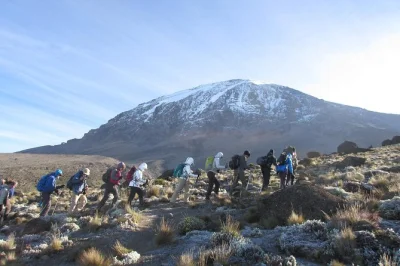
The second day is the long one: 7-8 hours and 16 kilometers across heather moorland scattered with volcanic rock, climbing to Shira 2 camp at 3,850 meters. The trail steepens gradually, streams cross your path, and if the clouds lift you'll see Uhuru Peak waiting ahead and the Northern Ice fields off to the west. This is where acclimatization starts working—the steady climb is designed to let your body adjust before the altitude gets serious. Days three and four keep moving you higher but slower: the Lava Tower (called the "Shark's Tooth") at 4,650 meters, then a descent to Barranco Camp, then the steep Barranco Wall, then Karanga Valley. The pattern is climb, camp, rest, repeat. By day five you're at Barafu Camp at around 4,600 meters with views of the summit, and you've done the South Circuit—you've seen Kilimanjaro from every angle.
Day six is the summit push. You leave Barafu around 2 a.m., climbing in darkness with a headlamp through heavy scree toward Stella Point on the crater rim. This is the part people talk about afterward—the mental and physical wall, the cold, the altitude pressing down. From Stella Point it's another hour to Uhuru Peak at 5,895 meters, and you might walk through snow to get there. Once you're standing at the highest point in Africa, you turn around and descend the same day, dropping 13 kilometers down to Mweka Camp by evening. Day seven is the final 3-4 hour walk down to Mweka Park Gate, where you collect your summit certificate and a vehicle drives you back to Moshi. The whole trek is seven days and six nights in a tent, with guides, rangers, and the mountain itself deciding whether you make it.
Safety is built into the route: the Lemosho approach is less crowded than Marangu, the acclimatization schedule is gradual, and an armed ranger walks with you the whole way. The company tailors the trek to dietary needs and special requests. You're camping the entire time, not in huts, which means you're fully committed to the mountain and to the people around you.

What’s included
- All Kilimanjaro National Park fees and taxes.
- camping accommodation for six nights.
- armed park ranger throughout the trek.
- guides and porters.
- descent to Mweka Park Gate and return transport to Moshi on day seven.
Operated by Uprise Africa Explorer
Is this one for you?Book this trek if you want to climb Kilimanjaro on a route with fewer crowds and more built-in acclimatization time, and you're willing to commit to seven days of camping and walking at altitude—the slower pace and the ranger's presence are what make the mountain safer and the summit more reachable.
Traveler reviews
Compare the 9 similar options
 Kilimanjaro 7-Day Lemosho Route Trek & Summit★ 4.97 (33)7dEN · DE +3US$ 3,000
 8-day Lemosho Route Kilimanjaro trek: scenic ascent to Uhuru PeakClimb Mount Kilimanjaro via the 8-day Lemosho Route with a private guide in English, French or German, featuring gradual ascents, fewer crowds★ 5.00 (9)8dEN · DE +1US$ 2,890View ›
 7-Day Kilimanjaro Machame Route Trek: Uhuru Peak SummitClimb Kilimanjaro's Machame Route over 7 days with expert guides and camp crew providing meals, reaching Uhuru Peak at 5,895 m with a 98% summit success rate.★ 5.00 (2)9dEN · AR +4US$ 3,200View ›
 Kilimanjaro Machame Route Trek 7 Days Summit CertificateTrek Mount Kilimanjaro via the Machame Route over 7 days with expert guides, all meals on the mountain, camping gear and a stamped summit certificate★ 5.00 (5)7dENUS$ 1,985View ›
 Mount Kilimanjaro 6-Day Trek: Machame Route from MoshiTrek Mount Kilimanjaro's Machame Route in 6 days from Moshi with professional guides, all meals on the mountain, camping, and private transfers★ 5.00 (3)6dENUS$ 799View ›
 Kilimanjaro Machame Trek: 7 Days to Uhuru Peak7-day Machame Route trek on Mount Kilimanjaro with hotel pickup, park fees and mountain camps included. Reach 19,345ft summit via Shira Plateau and Barafu Camp.★ 5.00 (1)8dEN · DE +3US$ 3,200View ›
 Lemosho Route Kilimanjaro Trek: Scenic 2-Day ClimbTrek Mount Kilimanjaro via the Lemosho route, the most scenic trail with lower crowds and strong summit success rates. Includes park entry★ 5.00 (12)2dEN · FR +1US$ 2,700View ›
 6-Day Marangu Route Kilimanjaro Trek: Summit Uhuru PeakTrek Mount Kilimanjaro via the Marangu Route over 6 days with professional guides, porters and cooks included—start in rainforest★ 5.00 (2)6dENUS$ 1,800View ›
 Kilimanjaro 5-day hike Marangu Route: summit Uhuru PeakClimb Kilimanjaro's Marangu route to 5,895m in five days with full support including hut stays, meals, guides and park fees for a successful summit.★ 5.00 (1)5dEN · DE +3US$ 2,520View ›
Top questions
What's the difference between Lemosho and other Kilimanjaro routes?
Lemosho approaches from the west and is less crowded than Marangu or Machame. It includes more acclimatization days and a longer approach, which improves summit success rates.
Do I need to be very fit to climb Kilimanjaro?
The trek is suitable for all physical fitness levels. Success depends more on acclimatization and mental determination than on athletic ability. The pace is slow and deliberate.
What happens if I don't reach the summit?
The trek continues; you descend with the group. Many people turn back at Stella Point or Barafu Camp due to altitude, and that's normal. You still receive the full experience and the descent.
Is there a weight limit or age limit?
The trek is not recommended for pregnant travelers. There are no stated age or weight limits; accessibility varies by individual fitness and altitude tolerance.
How much does it cost?
Pricing is not listed in the standard package details. Contact the operator directly for current rates.
What's included in the price?
All Kilimanjaro park fees and taxes, camping, guides, and an armed ranger are included. Meals, transportation to/from Moshi, and personal gear are typically separate.
When is the best time to climb?
The dry seasons (June–October and January–February) are best. The trek operates year-round, but weather and visibility vary by season.
How do I get to Moshi?
Fly into Kilimanjaro International Airport (JRO) or Dar es Salaam, then arrange transport to Moshi. The operator can advise on connections.
Kilimanjaro 7-Day Lemosho Route Trek & Summit
7d · EN · DE +3 · at your hotel
from US$ 3,000 per person
★★★★★★★★★★4.9733 reviews
