
Fez Medina: Private Half-Day Walking Tour & Hotel Pickup


Fez medina’s winding alleys, centuries-old mosques, crafts echoing in the air
You’ll step through Bab Bou Jeloud’s blue archway into Fez’s tangled medina, follow your private guide past madrasa courtyards and spice-laden souks, peek into centuries-old mosques, and watch artisans at work in hidden corners. Expect sensory overload, in all the best ways, and moments that linger long after you’ve left those winding alleys behind.
Compare the 12 alternatives
 Private Walking Tour of Fez Medina: Guided with Local ExpertEvery day · First departure 09:00, last 15:00★ 4.97 (400)3h–4hENUS$ 26View ›
 Fez Medina: Private Walking Tour with Hotel PickupEvery day · First departure 09:00, last 14:00 · All ages★ 4.92 (131)4hEN · AR · FR
 Fez Medina: Private Walking Tour with Local Guide & PickupEvery day · First departure 08:00, last 15:00 · From age 10★ 4.86 (101)4hEN · FRUS$ 22View ›
 Fes medina walking tour with local guide: Souks, madrasa, tanneryEvery day · First departure 09:30, last 15:00 · Up to age 80★ 4.90 (102)4hEN · IT · FRUS$ 27View ›
 Fez Medina: Half-Day Walking Tour with Official Guide & Hotel PickupEvery day · First departure 08:00, last 18:30 · From age 8★ 4.91 (77)3h–4hEN · DE · IT · FR +1US$ 25View ›
 Private Fez Medina Walking Tour: Kairaouine, Tannery & MoreEvery day · From age 12★ 4.95 (88)3h–4hEN · AR · DE · IT +2US$ 46View ›
 Private Walking Tour Fez Medina: Artisan Workshops & SouksEvery day · First departure 09:00, last 15:00 · From age 10★ 4.92 (84)3h–4hEN · IT · FR · ES
 Fez: Medina Walking Tour, Royal Palace & GardensEvery day · 03:00, 10:00 and 15:30★ 5.00 (90)3h–4hENUS$ 17.13View ›
 Fez Medina Walking Tour with Local Guide: Private & CustomizableEvery day · First departure 09:30, last 14:30 · From age 3★ 4.96 (245)3hEN · FRUS$ 43View ›
 Fes: Private Medina Tour, Tannery & Artisan WorkshopsEvery day · First departure 09:30, last 14:00★ 4.61 (97)5h–6hEN · IT · FR · ESUS$ 68View ›
 Fez Medina Half-Day Tour: Artisan Workshops & Ancient MosquesEvery day★ 4.96 (141)3h–4hEN · IT · FRUS$ 20View ›
 Fez Medina: Private Walking Tour with Tannery & MuseumEvery day · 10:30 and 14:30★ 4.96 (72)3h–4hEN · FRUS$ 46View › Compare more experiences like this »
Step-by-step itinerary
Explore Fez Medina's historic sites
- Pass by Bab Bou Jeloud gate
- Visit Bou Inania Madrasa
- Walk through Talaa Kebira market
- See Nejjarine Museum and fountain
- View Zaouia Moulay Idriss II from hill
- Pass by Kairaouine Mosque
- Visit Al-Attarine Madrasa
- Observe traditional tannery
- Stop at Place Seffarine square
The experience
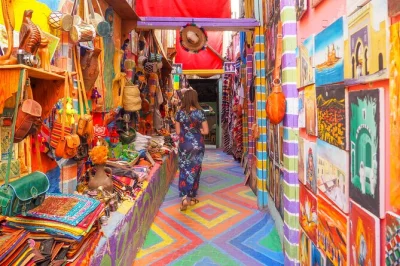
The first thing I remember is the color: Bab Bou Jeloud’s tiles, that deep blue against the morning bustle. Our guide, Youssef, was waiting just outside the gate with a grin and a bottle of cold water (he called it “Moroccan air conditioning”, not wrong). Stepping inside the Fez medina felt like walking into a labyrinth that’s alive. There were shouts from vendors, the clatter of carts on stone, and somewhere nearby, someone frying something that smelled both sweet and savory at once. I tried to keep up but kept getting distracted by everything: spices piled high like little mountains, old men playing cards in doorways. Youssef laughed and told us not to worry about getting lost. “Everyone gets lost here,” he said, “even me.”
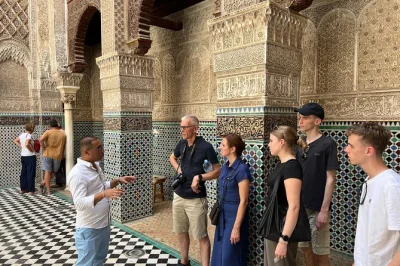
We ducked into Bou Inania Madrasa: honestly, I’d seen photos before but standing there with sunlight slanting across the carved cedar was different. You could smell dust and wood polish. Youssef explained how students used to memorize texts here. He even recited a line in Arabic (I tried repeating it back and got an approving nod, maybe he was just being polite). The Kairaouine Mosque loomed nearby. Non-Muslims can’t go inside but we peeked through a doorway while women in bright scarves hurried past us. The whole place felt layered: history stacked on top of daily life.
I didn’t expect to be so fascinated by the Nejjarine Museum of Wooden Arts and Crafts. The building itself is worth it (tiles underfoot, cool shade inside), and upstairs you get this view over rooftops where laundry flaps like flags. At one point we heard the call to prayer echoing between walls. Everything paused for a second except for two cats chasing each other around sacks of olives. We wandered past Zaouia Moulay Idriss II (you can’t go in unless you’re Muslim), but Youssef showed us how locals leave fruit as offerings at the door. He told us five pilgrimages here equals one hajj: that stuck with me.
The tannery was… well, unforgettable for my nose. Pungent doesn’t cover it but watching men dip hides into vats of dye was strangely hypnotic. Someone handed me a sprig of mint to hold under my nose (pro tip: take it). By the time we reached Place Seffarine with its clang of copper workers’ hammers, I’d stopped trying to take photos and just watched for a minute instead. There’s something about Fez that makes you want to slow down, even if you’re only here for a half day tour with a private guide.
What’s included
- Your half day includes hotel or riad pickup and drop-off so you don’t have to navigate early morning streets alone.
- bottled mineral water to keep you going as you explore.
- plus all guiding is private so it’s just your group moving through Fez’s maze together at your own pace before returning comfortably back at your door.
Before you book
Prices and times updated 6 days ago
Operated by Adil Sahara Tours
Traveler reviews
Top questions
What languages is the guide in?
Live guide in English, Spanish, French and Italian.
How long does the Fez medina private tour last?
The private walking tour covers roughly half a day within Fez medina.
Is hotel pickup included in this Fez medina tour?
Yes, hotel or riad pickup and drop-off are included.
Which sites are visited on this Fez half day tour?
You’ll see Bab Bou Jeloud gate, Bou Inania Madrasa, Kairaouine Mosque (from outside), Zaouia Moulay Idriss II (from outside), Nejjarine Museum of Wooden Arts and Crafts, Al-Attarine Madrasa, local markets, tanneries, and Place Seffarine.
Can non-Muslims enter Kairaouine Mosque or Moulay Idriss shrine?
No, non-Muslims can only view these sites from outside or designated viewpoints.
Is this tour suitable for children or people using wheelchairs?
Yes, the route is wheelchair accessible and infants can join in strollers or prams.
Will I see traditional craftsmen at work during this Fez medina tour?
Yes, you’ll pass through areas where artisans work with wood, copper, leather and more.
Does this tour include lunch or food tastings?
No meal is included but you’ll pass many food stalls along the way.
Fez Medina: Private Half-Day Walking Tour & Hotel Pickup
3h 30m · EN · ES · FR · IT · at your hotel
from US$ 46 per person
4.79116 reviewsVerified traveler reviews via our booking provider