
Pompeii & Herculaneum tour with archaeologist: Skip the lines


Walk through two Roman cities frozen by Vesuvius, guided by an archaeologist who has spent 31 years reading the stones.
A private full-day tour of Pompeii and Herculaneum with a professional archaeologist guide, private vehicle and flexible itinerary. You visit both archaeological sites at your own pace, see the Forum, Temple of Apollo, House of the Vettii, Teatro Grande, and in Herculaneum the House of Neptune, the Women's Baths, and the Ancient Beach where 300 residents were found. Admission fees (around €40 per adult; free for children under 18 with ID) are separate; a winery lunch with wine tasting on Vesuvius slopes costs around €50 per person and is optional.
 8h–9h
8h–9h

Step-by-step itinerary
Explore Pompeii, Herculaneum, and Winery
- Visit Piazza Porta Marina entrance
- Tour Temple of Apollo ruins
- Explore Forum of Pompeii
- Visit House of the Vettii
- See Insula dei Casti Amanti
- Explore Teatro Grande
- Visit Antiquarium of Pompeii museum
- Tour Herculaneum Archaeological Park
- Visit Antiquarium of Herculaneum
- See Boat Pavilion exhibit
- Walk Ancient Beach of Herculaneum
- Visit House of the Cervi
- Explore House of Neptune and Amphitrite
- Tour Women’s Baths in Herculaneum
- Visit Palestra gymnasium
- Enjoy lunch and wine tasting at Cantina del Vesuvio winery

The Experience
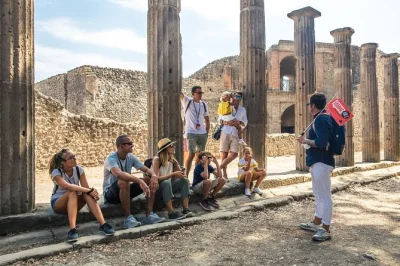
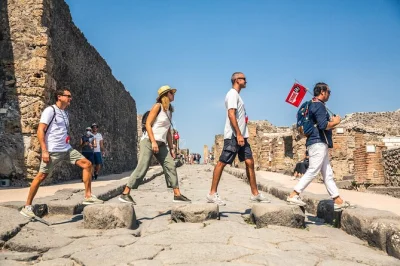
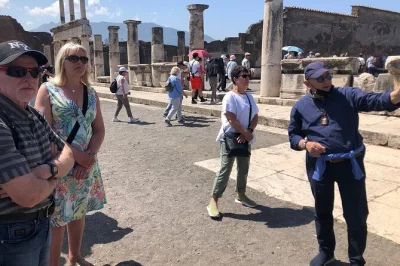
You arrive at your hotel or meeting point and step into a private Mercedes van with Fabrizio, an archaeologist who has guided visitors through these ruins for over 31 years. The tour runs 8 to 9 hours and covers both sites without the crowds that gather at the ticket gates. He knows which streets fill first and where to stand to see what matters—the Forum's original travertine stones, the Temple of Apollo's 48 columns framing Mount Vesuvius in the distance, the House of the Vettii's restored frescoes so vivid they look freshly painted. You walk at your own pace. He adapts the route to what interests you, whether that is the charcoal sketches of gladiators drawn by children 2,000 years ago in the Insula dei Casti Amanti, or the plaster casts in the Antiquarium that capture the final moments of eruption victims.
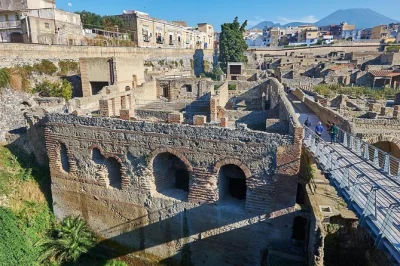
Herculaneum sits lower and narrower than Pompeii, preserved differently by the volcanic mud. You see the House of Neptune and Amphitrite with its gold-and-blue glass mosaic, the Women's Baths with their intact barrel-vaulted ceilings and black-and-white floor mosaics, and the Palestra with its monumental swimming pool shaped like a five-headed hydra. The Ancient Beach, reopened in 2024, lets you stand on the original volcanic sand where the fornici (boat sheds) still arch overhead—the place where over 300 residents were found huddled together. The Boat Pavilion shows the carbonized keel of a 9-meter vessel, perhaps sent to aid evacuation. These details ground the eruption in human scale.
Between the two sites, you can stop at Cantina del Vesuvio, a family-run winery on the slopes of Mount Vesuvius National Park, for a pre-set lunch and wine tasting (€50 per person all-inclusive, or €60 with a superior wine upgrade—you pay on-site by card or cash). A 15-minute walk through the vineyards introduces the Lacryma Christi wines; the meal pairs five local wines with bruschetta, cheeses, cured meats, spaghetti with Vesuvius cherry tomatoes and meatballs, and Neapolitan Pastiera, with vegetarian and gluten-free options available. This is optional and separate from the tour price. The van is air-conditioned, stocked with water and Wi-Fi, and Fabrizio speaks English, Spanish, Italian and French.

What’s included
- Private transportation in an air-conditioned Mercedes van.
- water and Wi-Fi on board.
- private guided tour of both Pompeii and Herculaneum with an archaeologist guide.
- flexible itinerary adapted to your pace and interests.
- skip-the-line access to both sites.
Operated by Fabrizio Belleni - Leisure Italy Private Guide
Is this one for you?Book this tour if you want to understand what you are looking at rather than move through a checklist—Fabrizio's 31 years studying these ruins means you see the details that matter, from the preserved wooden shelves in Herculaneum's grocery store to the frescoes most visitors miss. The private van and flexible route let you linger at what holds you instead of keeping pace with a group, and the winery stop on Vesuvius slopes is optional, so you can spend the full day in the ruins if that is what you prefer.
Traveler reviews
Compare the 13 similar options
 Pompeii & Herculaneum tour with archaeologist: Skip the lines★ 5.00 (96)8h–9hEN · IT +2€ 890
 Pompeii & Mt. Vesuvius Day Trip from Sorrento Crater RimFull-day tour from Sorrento with skip-the-line Pompeii entry, guided walk, and hike to Vesuvius crater rim. Includes transport and guide.★ 4.65 (1,559)8hEN · FR +1€ 115View ›
 Pompeii Tour from Sorrento: Skip the Line, Ancient StreetsSkip-the-line entry to Pompeii Archaeological Site from Sorrento with official guide, round-trip transport and headphones — walk the Forum★ 4.57 (889)5hEN · FR +1€ 75View ›
 Pompeii & Vesuvius: Ruins, Crater Hike & Winery LunchStep into Pompeii’s ancient streets, taste Vesuvian wines at a local winery, and hike to Mount Vesuvius’ crater—all with skip-the-line tickets and pickup included.★ 4.60 (167)9hEN€ 155View ›
 Amalfi Coast Private Day Trip from Sorrento: Customizable StopsPrivate full-day tour of the Amalfi Coast from Sorrento with a driver who knows the coast and stops where you want—Positano, Amalfi, Ravello8hEN · ES€ 370View ›
 Pompeii & Vesuvius Day Trip from Sorrento with PizzaFeel the heat of Vesuvius, wander ancient Pompeii, and share real Neapolitan pizza on this guided day trip from Sorrento—includes pickup and all entry fees.★ 4.68 (122)8h 30mEN · ES€ 115View ›
 Pompeii & Herculaneum Day Tour from Sorrento with Skip-the-LineTwo UNESCO sites in one day from Sorrento: Pompeii and Herculaneum with skip-the-line entry, professional guide, transport, and light lunch included. Groups capped at 25.★ 4.54 (319)8hEN€ 96View ›
 Pompeii Express Guided Tour by Train from Sorrento: Skip the LineSkip-the-line Pompeii tour from Sorrento with entrance fee, local train ride and English-speaking archaeologist guide for 2 hours among the ruins★ 4.69 (935)2hEN€ 55View ›
 Pompeii Guided Tour From Sorrento: 2-Hour Archaeological WalkSmall-group archaeological tour of Pompeii from Sorrento with skip-the-line entry and hotel pickup included—walk the Forum★ 4.85 (199)4h–5hEN€ 134View ›
 Pompeii & Amalfi Coast Private Day Trip from SorrentoPrivate car tour from Sorrento: Pompeii ruins, Positano, Amalfi Cathedral & Ravello option. Local driver, hotel pickup, air-conditioned vehicle, full day included.★ 4.97 (347)8hEN€ 400View ›
 Sorrento: Pompeii & Mount Vesuvius Crater Climb with GuideFull-day tour from Sorrento with Pompeii ruins walk, Mount Vesuvius crater climb, park entry and minibus transport. Hotel pickup and early afternoon return included.★ 4.90 (30)8hEN€ 122View ›
 Sorrento: Amalfi Coast & Pompeii Private Tour with DriverPrivate Amalfi Coast tour from Sorrento with stops in Positano, Amalfi, Ravello, and Pompeii. Air-conditioned vehicle, customizable itinerary, local driver-guide.★ 5.00 (123)6h–8hEN · IT€ 950per groupView ›
 Herculaneum Day Trip from Sorrento: Small Group, Expert GuideSmall-group tour of Herculaneum from Sorrento with expert English-speaking guide, entrance tickets and air-conditioned transport included7hEN€ 125View ›
Top questions
What is the House of the Vettii and why is it worth seeing?
The House of the Vettii is an opulent residence owned by two wealthy former slaves, recently restored and now called the "Sistine Chapel" of Pompeii for its exceptionally vivid Fourth Style frescoes. Inside, the Room of the Cupids displays charming scenes of ancient trades, the dining halls hold mythological murals still sharp and colorful after 2,000 years, and the central peristyle garden has working fountain statues and historically accurate plantings that recreate the luxury and status of Pompeii's elite.
Can I see the people who died in the eruption?
The Antiquarium of Pompeii and the Antiquarium of Herculaneum both house plaster casts that capture the final moments of victims, including a faithful guard dog at Pompeii. At Herculaneum's Ancient Beach, you can stand where over 300 residents were discovered huddled in the fornici (boat sheds), and the Boat Pavilion displays artifacts found with them, including carbonized rope and fishing weights that show their last moments before the pyroclastic flows.
Is the tour suitable if I'm traveling with children?
A kid-friendly version of the tour is available for children aged 6 to 11, adapted to their pace and interests. Specialized infant seats are available in the vehicle. The tour is not recommended for travelers with spinal injuries, pregnant travelers, or those with poor cardiovascular health; you should have at least a moderate level of physical fitness.
Does the tour go up Mount Vesuvius itself?
The tour does not reach the summit of Mount Vesuvius. It includes a stop at Cantina del Vesuvio, a winery on the slopes within the National Park, where you can see the volcano's crater and the Bay of Naples from the vineyard, but the main focus is the two buried cities below.
What is included in the price, and what costs extra?
The tour includes private transportation in an air-conditioned Mercedes van, water and Wi-Fi on board, and a private guided tour of both Pompeii and Herculaneum with Fabrizio. Admission fees (approximately €40 per adult for both sites; free for children under 18 with valid ID) are separate. The optional winery lunch with wine tasting costs around €50 per person all-inclusive and is paid on-site.
How long is the tour, and when does it start?
The tour runs 8 to 9 hours. Pickup is included, and Fabrizio will arrange the meeting time and location with you based on where you are staying.
Pompeii & Herculaneum tour with archaeologist: Skip the lines
8h–9h · EN · IT +2 · at your hotel
from € 890 per person
★★★★★★★★★★5.0096 reviewsVerified traveler reviews via our booking provider
