
Jinka: Omo Valley Tribes 3-Day Expedition: Mursi & Hamar
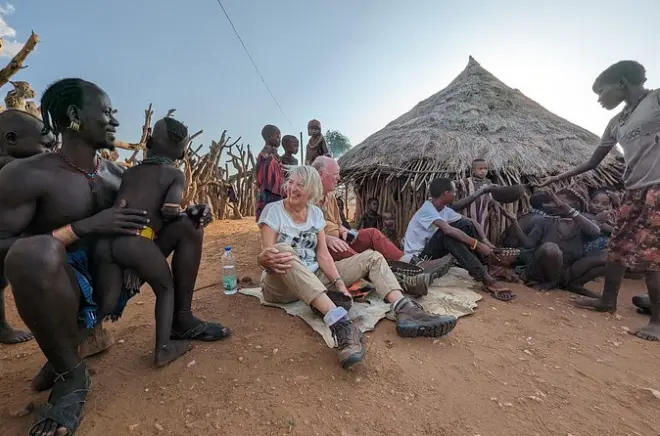


Four distinct tribes, three days, one guide who explains what most tours miss
A 3-day tour from Jinka into the Omo Valley's four most culturally distinct communities, traveling by private 4x4 with a professional English-speaking guide and staying overnight in Turmi and Jinka. Day one reaches the Mursi, whose women's lip plates carry precise bride-wealth value (a large plate worth 60 cattle, a smaller one 40), and the Hamar, whose men shape their hair with clay and ostrich feathers, maintaining the style on a wooden neck-rest called a borkotos. Day two crosses to the Karo of Korcho, a community of 1,500 to 2,000 people on the Omo River whose bodies carry intricate chalk and ochre patterns, and the Nyangatom, whose elders wear ivory lip plugs. An evening Evangadi dance in Turmi, a traditional Hamar courtship ritual, is subject to availability.
More experiences you might like
 4-Day Omo Valley Tour from Jinka: Tribal Ceremonies & MarketsEvery day · Up to age 75★ 5.00 (1)4dENUS$ 750View ›
 4-Day Omo Valley Cultural Tour: Mursi, Hamar, Karo & DassanechEvery day · 18:30 · From age 8★ 4.71 (7)4dENUS$ 1,200View ›
 Omo Valley Tribes: 3 Day Tour with Markets & RitualsEvery day · First departure 08:30, last 21:30★ 5.00 (16)3dEN · ESUS$ 900View ›
 5-day Omo Valley tour from Jinka: Four tribesEvery day · All ages★ 5.00 (18)5dENUS$ 1,400View › Compare more experiences like this »
Step-by-step itinerary
Day 1: Jinka to Mursi and Turmi
- Drive from Jinka to Mursi Village
- Meet Mursi community and observe lip plates
- Visit Turmi Hamar Tribe Town
- Attend Evangadi dance (subject to availability)
Day 2: Turmi to Karo and Nyangatom
- Travel from Turmi to Karo village of Korcho
- Explore Karo community and body art
- Visit Nyangatom village
- Return to Turmi
Day 3: Departure from Turmi to Jinka
- Morning drive from Turmi to Jinka
- Transfer to hotel or Jinka Airport
The experience
The Mursi and Hamar occupy the first day's drive from Jinka. The Mursi are immediately recognizable by their clay lip plates, a practice tied directly to bride wealth: the size of the plate signals economic value and social standing. The men are warriors whose bodies carry the scars of battles fought in the Omo Valley's inter-tribal conflicts. The Hamar, who inhabit Turmi, are semi-nomadic pastoralists raising large herds of cattle while cultivating honey, vegetables, tobacco, and cotton. Hamar women wear leather skirts decorated with shells, multiple copper bracelets, and heavy iron necklaces that signal social status. Their hair is styled with ochre and animal fat. The men who have achieved a hunting or warfare victory shape their hair with clay and crown it with a single ostrich feather, a hairstyle maintained using a special wooden neck-rest called a borkotos. In the evening, if the timing aligns, you may witness the Evangadi: a traditional dance performed after dark in which young men and women gather to sing and engage in the courtship rituals central to Hamar social life.
Day two travels south from Turmi to the Karo territory of Korcho, a settlement perched on the banks of the meandering Omo River. The Karo are one of the smallest ethnic communities in the entire Omo Valley, with a total population of only 1,500 to 2,000 people spread across three villages (Koricho, Duss, and Labuk) each separated by 14 kilometers. Their survival depends on the Omo River through agropastoralism and fishing. What makes them immediately striking is their body art: intricate patterns painted with chalk, charcoal, and ochre applied directly onto the skin, representing daily life, status, and identity. Their hairstyles are adorned with ostrich feathers, symbols of warrior bravery earned through conflicts with neighboring groups. Continuing south, you reach the Nyangatom, a pastoral people whose name translates as "Yellow Guns," reflecting a warrior identity that has defined their history in the lower Omo Valley. Their elders carry visible marks of cultural identity: men wear ivory lip plugs, women wear copper ones, and young girls dress in goatskin robes decorated with metal studs. The Nyangatom are known as the most formidable warriors of the Omo Valley, engaged in longstanding rivalries with neighboring communities, particularly during the dry season when territorial raids become possible.
Your professional guide facilitates respectful introductions throughout and explains the cultural differences between communities: the Karo's group bull-jumping ceremony for marriage, distinct from the Hamar's individual version; the social structures governed by elders and ritual chiefs; the specific meanings of body art, hairstyles, and adornment. The journey returns to Turmi in the afternoon, with the final morning a drive back to Jinka for your departure or hotel transfer. All meals are included across the three days except dinner on the departure day.
What’s included
- Private air-conditioned 4x4 vehicle.
- professional English-speaking guide.
- overnight accommodation in Turmi and Jinka.
- breakfast and lunch throughout the three days (dinner excluded on departure day only).
- all village visits and cultural introductions.
Before you book
Prices and times updated 5 days ago
Operated by Sphere Tours
Is this one for you?Pick this if you're flying into Jinka or based in town without a car: the private 4x4 and guide handle transport and route-planning across four spread-out communities, letting you focus on the cultural detail rather than logistics.
Traveler reviews
Top questions
Can children come?
Yes. Ticket types: Youth (14 to 24 years). Children under 14 can't be included in the booking.
What do Mursi lip plates actually represent, and how is their size determined?
Mursi women's clay lip plates carry direct social and economic significance: a large plate is worth 60 cattle in bride wealth, while a smaller one is worth 40. The size of the plate signals a woman's value and status within the community.
What is a borkotos, and why do Hamar men use it?
A borkotos is a special wooden neck-rest that Hamar men use to maintain their clay and ostrich-feather hairstyle. Men who have achieved a hunting or warfare victory shape their hair with clay and crown it with a single ostrich feather, and the borkotos keeps the style intact.
How many Karo people live in the Omo Valley, and where are their villages located?
The Karo are one of the smallest ethnic communities in the Omo Valley, with a total population of only 1,500 to 2,000 people living across three villages (Koricho, Duss, and Labuk) each separated by 14 kilometers. They live on the banks of the Omo River and depend on it for agropastoralism and fishing.
What marks the Nyangatom as distinct from other Omo Valley communities?
The Nyangatom, whose name translates as "Yellow Guns," are known as the most formidable warriors of the Omo Valley. Their elders wear ivory lip plugs (men) and copper ones (women), and young girls dress in goatskin robes decorated with metal studs. They maintain a pastoral heritage and warrior traditions tied to longstanding rivalries with neighboring communities.
Is the Evangadi dance guaranteed to happen on the evening of arrival in Turmi?
The Evangadi (a traditional Hamar dance performed after dark featuring courtship rituals) is subject to availability on the evening of arrival. It is a living expression of community identity, not a performance staged for visitors, so attendance depends on whether the community is gathering that night.
What is included in the three days, and what meals are covered?
The tour includes a private air-conditioned 4x4, a professional English-speaking guide, and full board (accommodation and meals) throughout the three days. Breakfast and lunch are included on the departure day. Dinner is not. Domestic flights to and from Jinka are not included.
Jinka: Omo Valley Tribes 3-Day Expedition: Mursi & Hamar
3d · EN
from US$ 790 per person
5.002 reviewsVerified traveler reviews via our booking provider