
7-day Kilimanjaro climb via Rongai Route: Quieter northern ascent
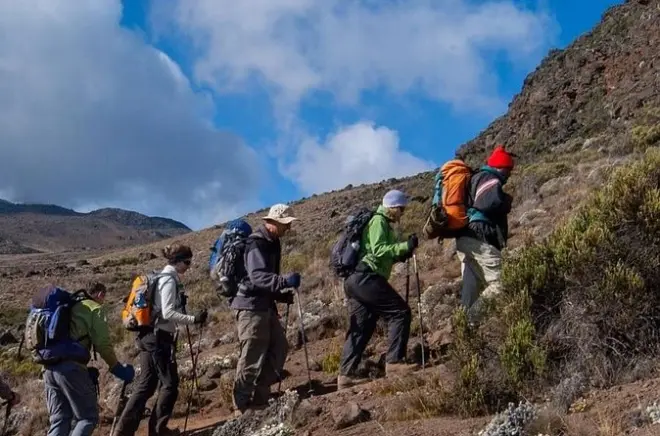


Seven days ascending Africa's highest peak through untouched wilderness, then down through rainforest
A 7-day Mount Kilimanjaro climb via the Rongai Route starts from the remote northern side near the Kenyan border and ascends through forest, moorland, and alpine desert to Uhuru Peak at 5,895 meters, then descends via the Marangu Route. The route's gradual slope and less-traveled path offer better acclimatization odds and quieter campsites. Private transport from Moshi or Arusha, entrance fees, government fees, and expert guide in your choice of language are included. Children from age 1 are welcome.
More experiences you might like
 6-day Kilimanjaro climb via Machame Route: Uhuru PeakEvery day★ 5.00 (1)6dEN · DE · IT · FR +1US$ 3,968View ›
 Kilimanjaro Climb Lemosho Route: Less-Crowded Path to Uhuru PeakEvery day★ 5.00 (4)8dEN · DE · IT · FR +1US$ 3,650View ›
 Tanzania Safari: Serengeti, Ngorongoro & Lake Manyara TourEvery day · 10:30 · Up to age 65★ 5.00 (10)5dEN · FRUS$ 2,950View ›
 Hot Air Balloon Safari Tarangire: Sunrise Flight & Bush BreakfastEvery day · 05:00 · From age 5★ 4.98 (250)5hEN · FR · ESUS$ 550View › Compare more experiences like this »
Step-by-step itinerary
Day 1: Rongai Gate to Simba Camp
- Transfer from Moshi or Arusha to Rongai Gate
- Register and attend briefing
- Trek through forest path
- Arrive at Simba Camp
Day 2: Simba Camp to Second Cave Camp
- Trek through open moorland
- Enjoy views of glaciers and terrain
- Arrive at Second Cave Camp
- Optional short acclimatization walks
Day 3: Second Cave Camp to Kikelewa Camp
- Trek gradual climb and steeper section
- Arrive at Kikelewa Camp
- Rest and acclimatize
Day 4: Kikelewa Camp to Mawenzi Tarn Camp
- Climb grassy slope to alpine desert
- Arrive at Mawenzi Tarn Camp
- Afternoon acclimatization hike
Day 5: Mawenzi Tarn Camp to Kibo Hut
- Cross saddle between Mawenzi and Kibo
- Arrive at Kibo Hut
- Rest and prepare for summit
- Attend evening briefing
Day 6: Summit to Horombo Hut
- Wake at midnight for summit push
- Ascend to Gilman’s Point and Uhuru Peak
- Celebrate at summit
- Descend to Kibo Hut for rest and meal
- Continue descent to Horombo Hut
Day 7: Horombo Hut to Marangu Gate
- Descend through heath and rainforest
- Pass Mandara Hut
- Arrive at Marangu Gate and sign out
- Receive summit certificate
- Transfer to hotel in Moshi or Arusha
The experience
The climb begins with a morning transfer from Moshi or Arusha to Rongai Gate at 2,000 meters, near the Tanzanian-Kenyan border. The first day's trek through forest takes 3 to 4 hours and ends at Simba Camp in the moorland zone, where colobus monkeys and tropical birds move through the canopy. The Rongai Route's defining feature is its gradual slope: each of the next three days climbs steadily but never steeply, moving through open moorland with views of Kibo's eastern glaciers, then into sparse alpine terrain. By day four, you're at Mawenzi Tarn Camp at 4,330 meters, set beneath the spires of Mawenzi Peak beside a mountain tarn: one of the route's most dramatic campsites. An acclimatization hike in the afternoon improves your odds for summit success.
Day five crosses the saddle between the two peaks, a barren lunar landscape at high altitude, reaching Kibo Hut at 4,700 meters where you rest before the midnight summit push. The ascent to Uhuru Peak takes 6 to 8 hours under starlight, passing Gilman's Point on the crater rim before reaching Africa's highest point at 5,895 meters. After photos and celebration, you descend back to Kibo Hut, then continue down to Horombo Hut at 3,720 meters: a single day of 12 to 16 hours of trekking that is both the most physically and mentally demanding of the climb. The final day is a long descent through heath and rainforest zones, passing Mandara Hut en route, ending at Marangu Gate where you receive your summit certificate and return to your hotel.
Expert guides speak English, Spanish, Italian, French or another language of your choice, and a full crew supports the climb at every camp. Tents are provided at each stop except Kibo Hut, where basic hut accommodation or tents are available. The descent via Marangu gives you two distinct perspectives of the mountain (the quiet northern approach on the way up, and the busier southern route on the way down) making the full 7-day arc a complete circuit of Kilimanjaro's character.
What’s included
- Private transportation from Moshi or Arusha to Rongai Gate and back to your hotel.
- entrance fee and government fees.
- expert guide in English, Spanish, Italian, French or another language.
- full crew support at every camp.
- tent accommodation at Simba, Second Cave, Kikelewa, Mawenzi Tarn, and Kibo camps.
- basic hut or tent at Kibo Hut.
- meals and water at each camp.
- fuel surcharge.
Before you book
Prices and times updated 3 days ago
Operated by Herbivore African Expeditions
Is this one for you?Choose this route if you're climbing for the first time or prioritize acclimatization over speed: the Rongai's gradual daily ascents and northern approach mean fewer climbers and better odds of reaching the summit than busier routes.
Traveler reviews
Top questions
What languages is the guide in?
Live guide in English, Spanish, French, German and Italian.
Can children come?
Yes. Ticket types: Youth (16 to 35 years); Child (4 to 15 years); Infant (1 to 3 years).
What happens if it rains?
It may be canceled due to bad weather. If that happens, you're offered another date or a refund. Free cancellation up to 24 h before the start.
What makes the Rongai Route different from other Kilimanjaro climbs?
The Rongai Route ascends from the remote northern side near the Kenyan border, following a gradual slope through untouched wilderness. It is less crowded than the popular Marangu and Machame routes, offers better acclimatization due to its gentle grade, and passes through forests, moorlands, and alpine desert with quieter campsites. The descent via Marangu provides a second, distinct view of the mountain.
How much trekking happens each day, and which day is the hardest?
Days one through five involve 3 to 6 hours of trekking as you climb gradually to Kibo Hut. Day six, the summit day, is the most demanding: you trek 6 to 8 hours up to Uhuru Peak starting at midnight, then descend 12 to 16 hours total to Horombo Hut, combining the ascent, summit time, and a long descent in a single push. Day seven is a 5 to 7-hour descent through rainforest to Marangu Gate.
What altitude will I reach, and how does the route help with acclimatization?
You summit at Uhuru Peak, 5,895 meters above sea level. The Rongai Route's gradual daily climbs (starting at 2,000 meters and rising roughly 500 to 700 meters per day until day five) allow your body to adjust steadily. Optional acclimatization hikes in the afternoon at Mawenzi Tarn Camp further improve your chances of reaching the summit successfully.
What is included in the price, and what do I need to bring?
Private transport from Moshi or Arusha, all entrance fees, government fees, and fuel surcharge are included. Expert guide support, crew, and tent accommodation at each camp are provided. You bring your own trekking gear, warm layers for high altitude, and personal items. The operator supplies tents and arranges all logistics on the mountain.
7-day Kilimanjaro climb via Rongai Route: Quieter northern ascent
7d · EN · ES · FR · DE · IT · at your hotel
from US$ 3,730.16 per person
5.001 reviewVerified traveler reviews via our booking provider