


Gobustan and Yanar Dag day trip from Baku: 6,000 rock engravings
Gobustan holds more than 6,000 rock engravings carved over 40,000 years, and they are still there.
This day trip from Baku combines three stops across the Absheron Peninsula and central Azerbaijan: the Gobustan Rock Art Cultural Landscape with its plateau of carved boulders, the natural gas fire at Yanar Dag that burns continuously on a hillside, and the Ateshgah Fire Temple, a 17th-century pentagonal complex built as a Hindu, Sikh and Zoroastrian place of worship. A guide in English or Russian leads the route, pickup is included from your hotel, and the price covers the whole day: no additional charges once you book.
Step-by-step itinerary
Explore Gobustan and Absheron highlights
- Visit Gobustan Rock Art Cultural Landscape
- See Azerbaijan's mud volcanoes by taxi
- Observe the natural fire at Yanar Dag
- Tour the Ateshgah Fire Temple in Baku
- Gobustan Rock Art Cultural Landscape Entry included 1h
- Yanar Dag Entry included 30m
- Ateshgah Fire Temple Entry included 40m
What’s included
- Hotel pickup and drop-off.
- air-conditioned vehicle for the main route.
- local taxi transfers to the mud volcanoes.
- bottled water throughout the day.
- guide in English or Russian.
- entry to all three sites.
Times
- Every day 09:00
Before you book
Operated by Amazing Azerbaijan
Prices and times updated 8 days ago
Need assistance?Message us on WhatsApp or by emailTraveler reviews
The experience
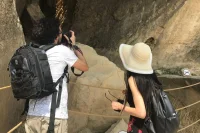
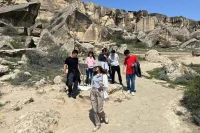
Gobustan spreads across 537 hectares of rocky plateau rising out of the semi-desert, and the rock art spans from the Upper Paleolithic through the Middle Ages. The engravings document how people lived here during the wet period after the last Ice Age, and the site also holds the remains of inhabited caves, settlements and burials. You walk among the boulders and see the carved marks directly, not photographs or reproductions, but the actual stone.
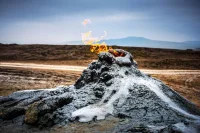
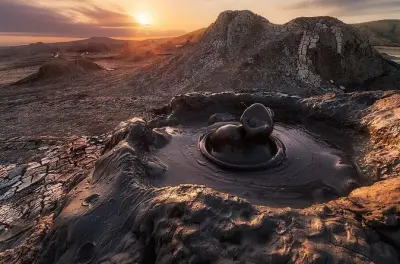
The route then moves to the mud volcanoes, where the road becomes rough enough that you transfer to local taxis (included in the price) for the bumpy stretch. Azerbaijan has 350 of the world's 800 mud volcanoes, and locals call them by several names: yanardagh for burning mountain, pilpila for terrace, gaynacha for boiling water. After that comes Yanar Dag on the Absheron Peninsula, where natural gas seeps from a thin sandstone layer and burns continuously, with flames jetting about 3 metres into the air. Unlike the mud volcanoes, there is no seepage of liquid. Just the steady fire, which locals say was first lit accidentally by a shepherd in the 1950s.
The final stop is the Ateshgah Fire Temple in Surakhani, a castle-like structure built in the 17th and 18th centuries with a pentagonal courtyard, monk cells and a tetrapillar altar in the middle. Persian inscriptions show it served Hindu, Sikh and Zoroastrian worshippers. The natural eternal flame went out in 1969 after petroleum and gas extraction drained the subsurface, but gas is now piped in to keep it lit. The tour runs 6 to 8 hours total, includes an air-conditioned vehicle for the main stretches, bottled water throughout, and a guide who speaks English or Russian.
Is this one for you?Book this if you want three major sites (ancient rock art, historical landmarks, and mud volcanoes) covered in one day with a single payment and no separate entry fees at each stop.
Compare the 12 alternatives







Top questions
What languages is the tour guided in?
Live guide in English and Russian.
Can children come?
Yes. Ticket types: Child (4 to 11 years); Infant (under 4).
What are the rock engravings at Gobustan, and how old are they?
The Gobustan Rock Art Cultural Landscape holds more than 6,000 carved engravings spanning 40,000 years of human activity, from the Upper Paleolithic period through the Middle Ages. They document how inhabitants lived on the plateau during the wet climate that followed the last Ice Age, and the site also contains the remains of caves, settlements and burials from that long occupation.
How does Yanar Dag work, and why does it burn?
Yanar Dag is a natural gas fire on the Absheron Peninsula that burns continuously because gas seeps steadily from a thin, porous sandstone layer beneath the hillside. Flames jet about 3 metres into the air, and unlike nearby mud volcanoes, there is no seepage of mud or liquid: only the gas fire itself, which locals say was first lit accidentally by a shepherd in the 1950s.
What is the Ateshgah Fire Temple, and who built it?
The Ateshgah is a castle-like religious complex in Surakhani, built during the 17th and 18th centuries as a place of worship for Hindu, Sikh and Zoroastrian communities. It has a pentagonal courtyard surrounded by monk cells and a tetrapillar altar in the middle. The natural eternal flame went out in 1969 after oil and gas extraction, but gas is now piped in to keep it burning.
Is lunch included in this tour?
Lunch is not included, but bottled water is provided throughout the day. You will have time to eat at a stop, or you can arrange a meal separately.
How long does the tour take, and what is the pickup arrangement?
The tour runs 6 to 8 hours total. Hotel pickup is included in the price, and a guide in English or Russian leads the route. You travel in an air-conditioned vehicle for most of the day, though you transfer to local taxis for the rough road to the mud volcanoes (that transfer cost is also included).
Gobustan and Yanar Dag day trip from Baku: 6,000 rock engravings
6h–8h · EN +1
from US$ 80 per person
Next, you choose your date and number of travelers and see the final price.