
Kyoto Imperial Palace and Nijo Castle Walking Tour: 7 hours


Walk through four centuries of Kyoto's power, from commoner temples to castle halls
A seven-hour guided walking tour of Kyoto covers the Kyoto Imperial Palace, Nijo Castle, Higashi Honganji temple and Nishiki Market with an English-speaking guide. The tour traces the lives of emperors, shoguns and ordinary people across the sites where their authority and faith took shape. Admission fees are separate. Public transportation fares are optional depending on which option you choose.
Compare the 8 alternatives
 Kyoto Imperial Palace & Nijo Castle Walking Tour: 3 HoursEvery day · 09:00 and 13:00★ 4.63 (188)3hEN · ZH · FR · ESJP¥ 6,137View ›
 Nijo Castle & Kyoto Imperial Palace: Private guided tourEvery day · 09:00 and 13:00★ 5.00 (23)2h 30mEN
 Private Kyoto tour: Nishiki Market, Nijo Castle, Imperial PalaceEvery day · 09:00, 09:30 and 10:30 · From age 7★ 5.00 (2)6hENJP¥ 20,000View ›
 Kyoto Morning Tour: Golden Pavilion & Imperial Palace VisitMon–Sat · 07:15 and 08:20 · All ages★ 4.46 (463)4h–6hENJP¥ 13,200View ›
 Nijo Castle and Imperial Palace tour Kyoto: 2.5 hours with guideEvery day · 09:00 and 13:00 · All ages★ 4.84 (58)2h 30mENJP¥ 11,987View ›
 Kyoto private tour: Nijo Castle, Imperial Palace, Fushimi InariEvery day · 09:00 · Ages 14–69★ 5.00 (25)6hEN · ESJP¥ 28,000View ›
 Kyoto tour: Fushimi Inari, Nijo Castle & Golden PavilionEvery day · First departure 08:00, last 11:00 · All ages★ 4.70 (23)5hEN · JAJP¥ 25,000View ›
 Nijo Castle Guided Tour Kyoto: Small Group with AdmissionEvery day · 10:00, 12:30 and 15:00 · All ages★ 4.98 (562)1h 30mENJP¥ 6,270View › Compare more experiences like this »
Step-by-step itinerary
- Nishiki Market30m
- Nijo Castle1h
- Kyoto Imperial Palace1h 15m
Explore Kyoto's cultural landmarks
- Visit Higashi Honganji temple
- Explore Nishiki Market and sample food
- Tour Nijo Castle and see painted sliding doors
- Walk through Kyoto Imperial Palace and gardens
The experience
The day starts at Higashi Honganji, a head temple of the Shingon Otani sect with about 9,000 affiliated temples across Japan. The Founder's Hall is the largest wooden building in the world, with over 900 tatami mats and space for 3,000 people at once. Walking through it, you stand in the scale of faith that shaped ordinary people (merchants and farmers) across centuries. The majestic atmosphere and the sheer size of the space make the depth of Japanese Buddhism tangible in a way no photograph conveys.
From there, the tour moves to Nishiki Market, called the kitchen of Kyoto. The market sits above a gigantic underground water reservoir that has fed the district for roughly 500 years. About 500 shops line the narrow streets, selling vegetables grown in that pure water, pickles made from them, tofu, and countless other daily goods. The guide explains why Kyoto's specialties (its vegetables and pickles) taste the way they do, and you can sample food from vendors who have served locals for centuries. This is where you taste what the description means.
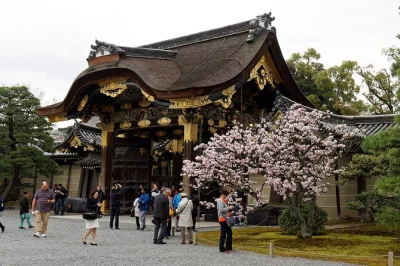
Nijo Castle comes next. Built in 1603 as the residence where the shogun stayed when visiting Kyoto, it holds more than 1,000 paintings on sliding doors that display the shogun's authority. The castle carries a specific historical weight: it was here, in 1867, that the last shogun declared the return of power to the Emperor after 260 years of his family's rule. Walking through the rooms, you move through the moment Japan's political order shifted.
The tour closes at Kyoto Imperial Palace, an extensive site in central Kyoto where the emperor's family lived until the capital moved to Tokyo in 1868. The luxurious buildings and gardens show the refined taste of the imperial court. The palace remains in use, when the emperor or crown prince visits Kyoto, they stay in one of the residences on the grounds. The walk is substantial across all four stops, and the guide ties together the faith of ordinary people, the power of the shogun, and the refinement of the imperial court into a single narrative of Kyoto's life.
What’s included
- An English-speaking guide leads the entire seven-hour walk.
- you choose whether to include public transportation fares depending on your option.
Before you book
Prices and times updated today
Operated by KAMNAVI Tours
Is this one for you?Your guide narrates in English throughout, connecting four major sites (commoner temples, imperial palace, shogun residence, and geisha district) in a single day without gaps in the story.
Traveler reviews
Top questions
What happens if it rains?
It may be canceled due to bad weather. If that happens, you're offered another date or a refund. Free cancellation up to 24 h before the start.
How much walking is involved in this Kyoto tour?
Quite a bit of walking is involved across the seven hours, so you should have at least a moderate level of physical fitness. The tour covers four major sites with walking between them, and you'll spend time inside each one.
What is Higashi Honganji and why does it matter?
Higashi Honganji is the head temple of the Shingon Otani sect, which has about 9,000 affiliated temples across Japan and roughly 8 million believers. Its Founder's Hall is the largest wooden building in the world, with over 900 tatami mats and the capacity to hold 3,000 people at once, showing the scale of faith that shaped ordinary Japanese people for centuries.
Can I sample food at Nishiki Market during the tour?
Yes. Nishiki Market has many shops where you can sample Kyoto's specialties, including vegetables, pickles and tofu made with the pure water that has blessed the district for roughly 500 years. The guide will explain why these foods are central to Kyoto's culinary identity.
What happened at Nijo Castle in 1867?
Nijo Castle is where the last shogun declared the return of power to the Emperor in 1867, ending 260 years of his family's rule. The castle holds more than 1,000 paintings on sliding doors that display the shogun's authority, and walking through it lets you stand in the rooms where that political shift took place.
Who lived at Kyoto Imperial Palace and when?
The emperor's family lived at Kyoto Imperial Palace until the capital moved to Tokyo in 1868. Even today, when the emperor or crown prince visits Kyoto, they stay in one of the residences on the grounds. The luxurious buildings and gardens show the refined taste of the imperial court across centuries.
Do I need to pay for admission separately?
Yes, admission fees to the sites are not included in the tour price and are paid separately. Public transportation fares depend on which tour option you choose at checkout.
Kyoto Imperial Palace and Nijo Castle Walking Tour: 7 hours
7h · EN
from JP¥ 17,042 per person
4.9010 reviewsVerified traveler reviews via our booking provider