
Dublin: LGBTQ Pride Walking Tour, Queer History & Culture


Queer voices echo from Temple Bar to Dublin Castle on foot
You’ll follow Dublin’s LGBTQ trail with a local guide, starting at Temple Bar and crossing landmarks like Ha’penny Bridge and Trinity College. Hear stories of activists and icons at places like GPO Witness History Centre and Abbey Theatre before ending at Dublin Castle. Along the way you’ll feel the city’s pride — sometimes loud, sometimes quiet — echoing through every stop.
 2h
2h

Step-by-step itinerary
Dublin LGBTQ Pride Historical Walking Tour
- Meet at Temple Bar district
- Cross Ha’penny Bridge
- Visit GPO Witness History Centre
- Explore Abbey Theatre
- Discuss first gay pride parade
- Visit Trinity College Dublin
- Explore queer Dublin in the 1980s
- Pass by River Liffey
- Visit Temple Bar gay headquarters site
- Visit Dublin’s oldest gay bar
- Finish at Dublin Castle

The Experience
The first thing I noticed was the rainbow sticker peeling off the lamppost outside Temple Bar — faded but stubborn, kind of like the city itself. Our guide, Aoife, waved us over with this bright scarf and a grin that felt like an invitation. She started right in, no fuss, pointing out where the first Pride protest gathered. I could hear buskers somewhere down the street mixing Bowie with trad Irish tunes. It just felt right.
We crossed Ha’penny Bridge — somehow always windier than you expect — and Aoife told us about Dr Lydia Foy and her fight for gender recognition in Ireland. The way she spoke about it made me realize how recent some of these changes are; it’s not all ancient history here. At GPO Witness History Centre, she paused, let us look up at the bullet holes still marking the stone. “Some of those revolutionaries were queer too,” she said quietly. I hadn’t learned that in school.
There was this moment outside Abbey Theatre when Aoife recited a bit from Panti Bliss’s Noble Call speech — her voice cracked just a little. I think everyone felt it. Later at Trinity College, students rushed by in their own worlds while we stood under that old arch talking about gay alumni who’d shaped Irish culture (I tried to picture them sneaking out for pints at The George). By then my feet were tired but I didn’t want to miss anything.
We finished inside the stone walls of Dublin Castle, sunlight flickering through clouds overhead. Someone asked about marriage equality and Aoife just smiled — “We’re still making history.” I keep thinking about that walk: how every street had its own story layered under the noise and traffic, waiting for someone to point it out.

What’s included
Your day includes a guided exploration of queer history across central Dublin with a nationally accredited guide; all routes are wheelchair accessible and you can bring strollers or service animals along if needed—just meet your group at Temple Bar before heading out together on foot.
Operated by Original Dublin
Traveler reviews
Compare the 13 similar options
 Dublin: LGBTQ Pride Walking Tour, Queer History & Culture★ 5.00 (106)2hEN€ 24
 Dublin: Hop-on Hop-off Bus Tour & Live Guide CommentaryCatch Dublin’s sounds from an open-top bus, hop off at Guinness Storehouse or Trinity College, and hear stories from a live guide. Flexible tickets with walking tour.★ 4.66 (2,886)1h 50mEN€ 30View ›
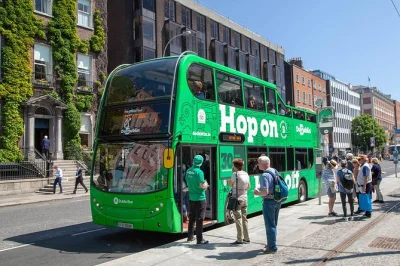 Dublin: Hop-On Hop-Off Bus Tour & Little Museum EntryFind your own rhythm in Dublin with a hop-on hop-off bus ticket, live guide, and entry to the quirky Little Museum. Includes 25 stops and free kids ticket.★ 4.54 (3,640)55m–1h 45mEN€ 29View ›
 Dublin: Guinness Storehouse & Big Bus Hop-on Hop-off 24/48hrGuinness Storehouse entry plus 24 or 48-hour hop-on hop-off bus tour covering 25 Dublin stops. Live commentary, free pint at the bar, mobile ticket. Wheelchair accessible.★ 4.40 (354)1h 30mEN€ 64View ›
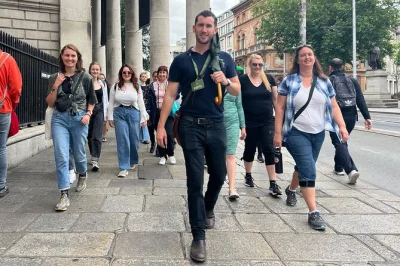 Dublin: Walking Tour with Castle, Bridges & Temple Bar StoriesFeel Dublin’s history come alive on a walking tour with local storytellers. Explore Dublin Castle, Trinity College, Temple Bar and more. Includes accredited guide.★ 4.94 (7,372)2hEN€ 24View ›
 Dublin: Open-Top Bus Hop-On Hop-Off & Walking TourRed open-top bus tour of Dublin with 25 stops, live commentary in 8 languages, free walking tour included. 24 or 48-hour pass, buses every 20-30 minutes.★ 4.45 (22)1h 30mEN€ 30View ›
 Haunted Dublin Walking Tour: Medieval streets & gothic secretsTemple Bar to St. Stephen's Green walking tour in Dublin with a guide. Explore medieval crime, grave robbing, and the Hellfire Club.★ 4.93 (1,079)2hEN€ 24View ›
 Dublin: Night Bus Tour & Lit Landmarks Open-TopOne-hour open-top night bus tour of Dublin with live guide. See Christ Church Cathedral, Trinity College, Temple Bar and Dublin Castle illuminated. Wheelchair accessible.★ 4.25 (126)1hEN€ 26View ›
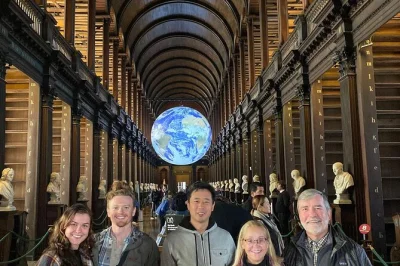 Dublin: Book of Kells Early Access & Castle Walking TourStep into Dublin’s heart with early access to the Book of Kells, a guided walk through castle grounds, and a singalong at Molly Malone—includes fast-track entry.★ 4.66 (4,237)2h 30mEN · DE +3€ 72View ›
 Dublin Cruise: Hop-on Hop-off Bus & DART Train from Dun LaoghaireHop-on hop-off bus tour of Dublin with 25 stops, live guide commentary, Little Museum entry and DART train ticket included for cruise passengers.★ 4.11 (124)1h 45mEN€ 39View ›
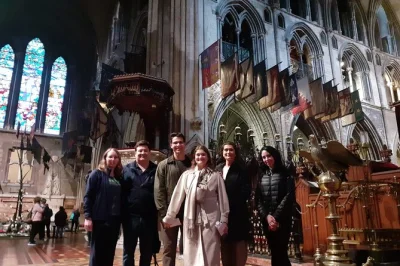 Dublin: St Patrick’s Cathedral, Book of Kells & Castle TourFeel Dublin’s soul on a guided tour with skip-the-line entry to St Patrick’s Cathedral, the Book of Kells at Trinity College & Dublin Castle. Includes priority tickets.★ 4.74 (1,495)3h 30mEN · DE +3€ 119View ›
 Dublin: Private Walking Tour City Highlights & StoriesFeel Dublin’s heartbeat on a private walking tour—explore Temple Bar, Trinity College, Dublin Castle & O’Connell Street with an Irish guide. Includes hotel meet-up.★ 4.99 (103)3hEN€ 211View ›
 Dublin: City Bike & Ebike Tour with Local StoriesPedal through Dublin’s streets on a guided bike or ebike tour, hearing local stories and music legends. Includes all equipment and relaxed city pace.★ 4.92 (925)2h 30mEN · NL€ 35View ›
Top questions
How long is the Dublin LGBTQ Pride walking tour?
The tour covers several central Dublin sites and typically lasts around 2-3 hours on foot.
Is this tour wheelchair accessible?
Yes, all areas and surfaces are wheelchair accessible and transportation options are available nearby.
Where does the LGBTQ walking tour start?
The tour begins in the heart of Dublin’s Temple Bar district.
Does the tour include entry fees or just outside visits?
The focus is on outdoor stops and stories; entry fees are not required for this walking route.
Who leads the Dublin LGBTQ Pride Historical Tour?
A nationally accredited local guide leads each group through Dublin’s LGBTQ history.
Are children or strollers allowed on this tour?
Yes, infants and small children can ride in a pram or stroller during the walk.
What major sites are included on this walking tour?
You’ll visit Temple Bar, Ha’penny Bridge, GPO Witness History Centre, Abbey Theatre, Trinity College, River Liffey, and finish at Dublin Castle.
Dublin: LGBTQ Pride Walking Tour, Queer History & Culture
2h · EN
from € 24 per person
★★★★★★★★★★5.00106 reviews
