
3-Day Fergana Valley Crafts Tour: Master Ceramists & Silk Weavers


Watch centuries-old craftsmanship unfold by hand, from raw clay to finished piece
A 3-day tour of Uzbekistan's Fergana Valley that takes you into the workshops of master ceramists in Rishtan and silk weavers in Margilan, guided by a local expert. You'll watch the complete ikat process (from silk thread preparation through natural dyeing to hand-weaving), and see how potters revive ancient glazing techniques. You stay in the craft towns themselves and eat with artisan families. A live guide speaks English, Russian, or Arabic. Private transportation and entrance fees are included. Children from age 5 are welcome.
Step-by-step itinerary
Day 1: Explore Kokand's historic sites
- Visit tiled entrance gate
- Tour surviving courtyards
- See carved wooden interiors
- Explore small history museum
- Visit large arcaded mosque
- Observe individually carved columns
- View freestanding minaret
Day 2: Discover Rishtan ceramics
- Visit large ceramics showroom
- Explore independent ceramic workshops
- Tour working studio-school
- Drive to Margilan
Day 3: Experience Margilan silk craft
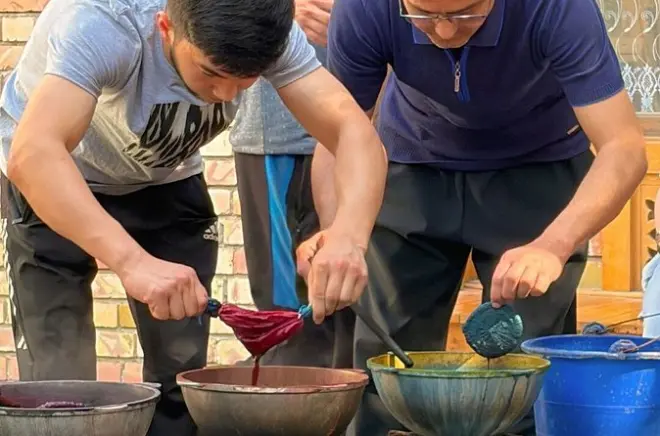
- Watch complete ikat process
- See batik tie-dyeing demonstration
- Shop at curated retail experience
- Visit local ikat market
The experience
Most visitors to Uzbekistan see the Silk Road monuments in Samarkand and Bukhara from a distance. This tour goes the other way: into the studios where the crafts still happen. You start in Kokand, exploring the tiled palace of the last khan with its carved wooden interiors and the arcaded mosque nearby, then drive an hour to Rishtan, where the real work begins. The town sits on deposits of blue clay that have fed ceramic workshops for centuries, and you'll spend time at several of them: the International Ceramic Center, a modern cluster of about fifteen independent studios opened in 2021; and Nazirov's studio-school, where the master still teaches apprentices and demonstrates the ishkor glaze process. An ancient technique made from desert plant ash that turns glass-like at extreme firing temperatures. You can join a masterclass covering every stage, from wheel-shaping to hand-painting.
Day two takes you to Margilan, the silk capital. At the Yodgorlik factory, you'll watch the complete ikat process unfold: silk thread preparation from raw cocoons, the mathematical pattern calculation that has to be exact or the whole design fails, precise tying and binding of thread sections, multiple rounds of natural dyeing, and finally hand-weaving on a traditional loom. The "impossible math" of ikat (where the pattern only appears once the pre-dyed threads are stretched and woven together) becomes clear when you see it happen. The factory also demonstrates batik tie-dyeing, a different technique that broadens the picture of Margilan's textile traditions. After the factory, you'll visit a retail shop known for knowledgeable staff and no pressure, then browse the Margilan bazaar itself on a Thursday or Sunday, where locals actually shop for ikat fabric and clothing among rows of fresh fruit, bread, and spices.
You stay in the craft towns themselves and eat with artisan families, not in a regional capital. Your guide handles the logistics and translation. Private transportation moves you between sites. As a personal gift, you'll receive a custom webpage capturing your own journey. Accommodations and meals are arranged separately, giving you flexibility on where and what you eat while the tour focuses on the work itself.
What’s included
- Private transportation between all sites.
- entrance fees to the ceramics studios, Yodgorlik factory, and Kokand palace.
- a live guide in English, Russian, or Arabic.
- hands-on masterclass opportunities at select workshops.
- a custom webpage capturing your journey as a personal gift.
Before you book
Prices and times updated 11 days ago
Operated by Javohir Ko’chkanboyev
Is this one for you?Three days is long enough to move beyond a quick demo and actually see how the work unfolds (from raw clay and cocoon to finished piece), but short enough to fit into a broader Uzbekistan itinerary. If you have only an afternoon or want to cover more ground across the country, a shorter visit to one town works. If you want to dive deeper into a single craft or spend time with one master, a longer stay is possible with advance arrangement.
Traveler reviews
Top questions
What languages is the tour guided in?
Live guide in English, Arabic and Russian.
Can children come?
Yes. Ticket types: Child (5 to 17 years). Children under 5 can't be included in the booking.
What exactly is the ikat process I'll see in Margilan?
Ikat is a 35-step textile technique where silk thread is prepared from raw cocoons, then sections are precisely tied and bound before being dipped in natural dyes multiple times. The pattern only appears once the pre-dyed threads are stretched and woven together on a traditional loom: a single miscalculation ruins the design. You'll watch the entire sequence at the Yodgorlik factory, from thread preparation through final weaving.
Can I actually try making ceramics or weaving myself?
Yes. At Nazirov's studio in Rishtan, guests can often join a masterclass covering every stage of the ceramic process, from wheel-shaping to hand-painting. The Yodgorlik factory in Margilan also offers hands-on opportunities during the ikat demonstration, though the focus is on watching the artisans work through the full sequence.
What is the ishkor glaze that Nazirov is known for?
Ishkor is an ancient ceramic technique Nazirov revived, made from the ash of a desert plant that turns glass-like at extreme firing temperatures. His work using this process is held in museum collections across Uzbekistan, Russia, and Japan, and he trained under a master of Japan's Kutani ceramic school. You'll see examples of his pieces and learn the process during your visit to his studio.
How much time do I spend shopping versus watching the craftspeople work?
The tour prioritizes the workshops and studios where the actual craftsmanship happens. After visiting the Yodgorlik factory in Margilan, you'll browse a retail shop with finished ikat textiles, then visit the Margilan bazaar on a market day (Thursday or Sunday). Shopping is built in, but the core of each day is spent watching the process unfold.
What's included and what do I arrange separately?
Private transportation, entrance fees, and guiding are included. Accommodations in the craft towns and meals are not included, so you arrange those separately, though your guide can help with recommendations. This gives you flexibility on where you stay and what you eat while the tour focuses on the workshops and artisan families.
3-Day Fergana Valley Crafts Tour: Master Ceramists & Silk Weavers
3d · EN +2 · at your hotel
from US$ 349 per person
5.005 reviewsVerified traveler reviews via our booking provider