
Gyeongju UNESCO Sites Tour: Bulguksa Temple & Seokguram Grotto


Two UNESCO temples, five centuries of Silla history, and lunch in between
An 8-hour small-group tour of Gyeongju visits Bulguksa Temple and Seokguram Grotto, the two UNESCO World Heritage Sites that anchor Korea's Buddhist legacy, with a guide, hotel pickup, all entrance fees and lunch included. A minimum of two participants is required for the tour to operate.
 8h
8h

Step-by-step itinerary
Explore Gyeongju UNESCO sites and history
- Visit Cheomseongdae Observatory
- Explore Wolji Pond and Imhaejeonji Palace
- Tour Gyeongju Gyochon Hanok Village
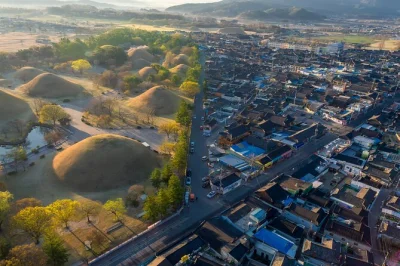
- See Daereungwon Tomb Complex
- Visit Seokguram Grotto on Tohamsan Mountain
- Explore Bulguksa Temple and its relics

The Experience
You start the day at your hotel, where the driver picks you up and takes you into Gyeongju, the ancient capital often called "the museum without walls." The route passes through the city's layered history — royal tombs, palace ruins, and stone monuments scattered across neighborhoods that have held the same ground for over a thousand years. The guide walks you through what you're seeing as you move between stops, so the city's shape begins to make sense instead of feeling like a collection of scattered sites.
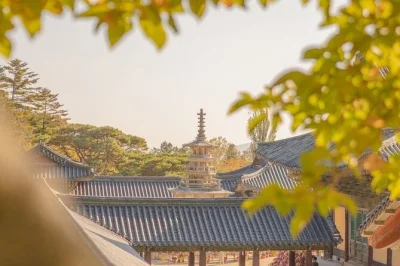
Bulguksa Temple comes first. Built in 751 and rebuilt over centuries, it holds eight National Treasures including two pagodas (Dabotap and Seokgatap) and four bridges with names that describe their function — the Lotus Flower Bridge, the Seven-Treasure Bridge. The temple's stone work is precise enough that you can see the craftsmanship from seven hundred years ago. From there, the drive climbs to Seokguram Grotto on Tohamsan Mountain, an artificial stone temple carved from granite and finished in 774. Inside the rounded chamber sits the Bonjon statue, a Buddha figure with a lotus-flower stage beneath it, and the ceiling curves like a half-moon. The grotto was built as a pair with Bulguksa — one temple for parents in this life, the tradition says, and one for parents in a former life. You'll also visit Cheomseongdae Observatory, the oldest existing astronomical observatory in Asia, built in the 7th century with 362 stones stacked to represent the days of the lunar year, and the Daereungwon Tomb Complex, where you can enter Cheonmachong and see the only known painting from the Silla era — a mounted horse discovered in the 1970s.
Lunch is included and served during the tour. The guide handles all entrance fees at each site, so you move through without stopping at ticket windows. The minivan is air-conditioned, and the pace gives you time to absorb each place instead of rushing between them. Wear comfortable shoes — the temple grounds and grotto involve walking on stone, and high heels will slow you down. Sunscreen is worth bringing; the observatory and tomb sites have little shade.

What’s included
- Hotel pickup and drop-off.
- professional guide in English or Korean.
- entrance fees to Bulguksa Temple, Seokguram Grotto, Cheomseongdae Observatory, and Daereungwon Tomb Complex.
- lunch.
- bottled water.
- air-conditioned minivan transport.
- skip-the-line access at each site.
Operated by Busan Tourism Center
Is this one for you?Your guide stays with you through Bulguksa Temple and Seokguram Grotto, adjusting the pace to match your interests rather than a group's schedule.
Traveler reviews
More experiences you might like
 Gyeongju UNESCO Sites Tour: Bulguksa Temple & Seokguram Grotto★ 4.81 (115)8hEN · KOUS$ 190
 Private Gyeongju Tour: UNESCO Sites with Guide & MealsPrivate tour of Gyeongju's UNESCO sites—Bulguksa Temple, Seokguram Grotto, Daereungwon Tombs, Cheomseongdae Observatory—with English-speaking guide★ 4.97 (320)8h–9hENUS$ 187View ›
 Gyeongju UNESCO Tour from Busan: Private Guide & Local LunchPrivate guided tour of Gyeongju's UNESCO sites from Busan or Gyeongju with licensed English-speaking guide and authentic local restaurant lunch★ 4.97 (371)4h–9hEN · KO +1US$ 187View ›
Top questions
What's inside Seokguram Grotto that makes it worth the climb?
Seokguram Grotto holds the Bonjon statue, a serene Buddha figure seated on a lotus-flower stage, surrounded by Bodhisattva figures and disciples inside a rounded stone chamber. The ceiling curves like a half-moon with a lotus-flower cover, and the grotto sits high enough on Tohamsan Mountain that sunrise from this spot draws visitors who climb at daybreak.
Can I see inside the ancient tombs at Daereungwon?
Yes. Cheonmachong tomb is open to visitors and contains 11,526 remains and royal crowns that show the lavish lifestyle of Silla royalty. The tomb also holds the only known painting from the Silla era — a mounted horse discovered during excavation in the 1970s.
How long does this tour take, and what's included in the price?
The tour runs 8 hours and includes hotel pickup and drop-off, a professional guide, all entrance fees to the sites, lunch, bottled water, and air-conditioned transport by minivan. You skip the ticket lines at each location.
What is Cheomseongdae Observatory, and why is it significant?
Cheomseongdae is the oldest existing astronomical observatory in Asia, built in the 7th century during Queen Seon-deok's reign. It stands 9.17 meters high, made of 362 stones stacked in 27 levels to represent the 362 days of the lunar year. Astronomers used it to observe stars and forecast weather, and to determine the equinoxes, solstices, and the 24 solar terms.
Is this tour suitable for children, and are there dietary options?
Children are welcome if accompanied by an adult. The tour is suitable for all fitness levels, though comfortable shoes are essential because you'll walk on stone at temples and tombs. Vegetarian lunch options are available — let the operator know at the time of booking.
What's the difference between the shared and private tour options?
The shared tour runs as a small group with other travelers; the private tour is just your group with a dedicated guide and driver. Both follow the same itinerary, visit the same sites, and include all entrance fees, lunch, and hotel pickup.
Gyeongju UNESCO Sites Tour: Bulguksa Temple & Seokguram Grotto
8h · EN · KO · at your hotel
from US$ 190 per person
★★★★★★★★★★4.81115 reviews
