


Amsterdam: Small-Group Walking Tour & Canal Belt
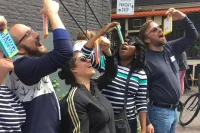


How a fishing village became the world's richest city, and what that means for how people live here now
You'll walk through Amsterdam's main squares and canal belt with a local guide who explains the city's transformation from fishing village to global power, stop at the Red Light District and dancing houses along the Singel, and learn how Dutch culture and diversity shape daily life. The guide shares insider recommendations on where to eat, drink and explore, and you finish near Westerkerk understanding how Amsterdam's "live and let live" philosophy actually works in practice.
Step-by-step itinerary
Explore Amsterdam's historic landmarks
- Meet at Dam Square National Monument
- Visit Beurs van Berlage stock exchange
- Play true-or-false game at Damrak
- View Amsterdam's canal belt and bike culture
- See Dancing Houses at Singel Canal
- Explore Torensluis and learn canal belt history
- Discover Dutch family culture at Emperor's Canal
- End at Westerkerk, Anne Frank House, Gay Monument
- Damrak 10m
- Singel Canal 10m
- Torensluis 10m
- Emperor's Canal 10m
- Westerkerk 10m
What’s included
- Your tour includes a local guide who leads you through Dam Square, the Beurs van Berlage, Damrak, the Singel Canal, Torensluis, the Emperor's Canal and Westerkerk.
- You'll learn about Amsterdam's history, Dutch culture and the city's approach to diversity and tolerance.
- The guide provides insider recommendations on where to eat, drink and explore neighborhoods on your own time.
Times
- Every day except Tuesday and Friday 10:00
Before you book
Operated by Who Is Amsterdam Tours
Prices and times updated 2 days ago
Need assistance?Message us on WhatsApp or by emailTraveler reviews
The experience
Dam Square is where the tour starts, right at the National Monument where the city's pulse is loudest. Your guide meets you there and doesn't waste time with the usual landmarks-and-dates routine. Instead, you get the story of how Amsterdam transformed from a small settlement into a global financial power in the 1600s, and how that history still shapes the way the city works today. The Beurs van Berlage, the old stock exchange, sits nearby, and your guide explains how Amsterdam pioneered trading systems that other cities copied. It's the kind of detail that makes you understand why the canals exist the way they do, why the neighborhoods are laid out as they are.
Walking through Amsterdam with a local guide means you stop at places most tourists pass without noticing. At Damrak, near the Red Light District, there's a quick true-or-false game about Dutch culture (coffeeshops, tolerance, the things Amsterdam is actually known for), and it lands differently when you're standing in front of the dancing houses, watching them lean at angles that shouldn't be structurally possible. The Singel Canal comes next, and your guide points out why these tilted buildings exist (the ground shifts, the foundations settle, and nobody tears them down because they're part of the story now). You see the canal belt (UNESCO-protected, built in the 1600s as a status symbol), and learn how 180 nationalities ended up living in neighborhoods that were designed centuries before most of them existed. At Torensluis, the conversation gets heavier: your guide talks about Amsterdam's role in the slave trade, not as a footnote but as something that shaped the city's wealth and the conversations happening there today.
The tour ends at Westerkerk, near the Anne Frank House and the Gay Monument. Your guide talks about what "live and let live" actually means in a city where that phrase gets tested constantly. You walk away with recommendations scribbled in your phone: a café in Jordaan where locals eat, a brown café where you can sit for hours, which neighborhoods to explore on your own. The whole thing takes around two hours, and the group stays small enough that you can actually hear what's being said and ask questions without holding up twenty other people.
Is this one for you?Book this if you want to understand how Amsterdam actually works (its history, culture and why people choose to live here) rather than just checking off landmarks. The small-group format and local guide mean you get context and recommendations you wouldn't find on your own.
Compare the 12 alternatives


Top questions
What happens if it rains?
It may be canceled due to bad weather. If that happens, you're offered another date or a refund. Free cancellation up to 24 h before the start.
How long is the Amsterdam walking tour?
Around two hours.
What's included in the tour?
A local guide, access to all stops (Dam Square, Damrak, canal belt, Westerkerk area), and insider recommendations on restaurants, cafés and neighborhoods to explore on your own.
Does the tour visit the Red Light District?
Yes, you pass through Damrak near the Red Light District and learn about Amsterdam's approach to tolerance and culture there.
Is the tour suitable for people with mobility issues?
The tour is suitable for all fitness levels and involves walking through city streets and along canals. Public transportation is available nearby if needed.
Are service animals allowed?
Yes, service animals are allowed on the tour.
What will I learn about Amsterdam?
The guide explains how Amsterdam became wealthy in the 1600s, why the canals and neighborhoods are designed as they are, Dutch culture and family life, and how the city's philosophy of acceptance shapes daily life.
Is this tour good for first-time visitors?
Yes, it's designed as a complete introduction to Amsterdam's history, culture and neighborhoods, with no prior knowledge required.
Can I ask questions during the tour?
Yes, the small-group format allows for questions and conversation throughout the walk.
Amsterdam: Small-Group Walking Tour & Canal Belt
2h · EN
from € 29 per person
≈ US$ 33 in your currency
Next, you choose your date and number of travelers and see the final price.