
Plain of Jars tour with local guide: 3 archaeological sites


Walk among ancient jars, wartime relics, and crafts made by Ban Naphia locals
A full-day Plain of Jars tour with an English-speaking driver-guide covers three archaeological sites, the spoon-making village of Ban Naphia, and the war-damaged remains of Muang Khun, the former capital of Xieng Khouang. Hotel pickup and lunch are included. The tour runs eight hours and is suitable for all fitness levels.
 8h
8h

Step-by-step itinerary
Explore Plain of Jars and local sites
- Meet guide and driver at hotel
- Travel 30 minutes to Ban Naphia village
- Visit Ban Naphia spoon making village
- Walk 10 minutes across rice field to Plain of Jars site 3
- Visit Plain of Jars site 3
- Lunch at Lak Khai
- Visit Plain of Jars site 2 at Ban Nakho
- Explore Muang Khun former capital
- See That Foun and Wat Phia Wat
- Visit final Plain of Jars site with 334 jars
- Return to hotel

The Experience
The day starts at your hotel with pickup by your driver-guide, then a 30-minute drive to Ban Naphia in Phaxay district. There you'll see how the village's thirty-plus families make their living—crafting and selling spoons formed from aluminum bomb casings left over from the Vietnam War. It's a direct look at how the war shaped daily life here, and why tourism matters to the local economy. From there, the route moves to the three jar sites themselves, each one different enough to justify the separate stops.
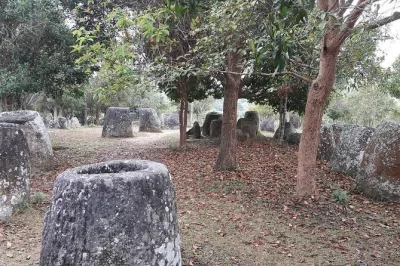
Plain of Jars site 3 comes first, around 10:00 AM in Ban Xieng di. A ten-minute walk across a rice field gets you there, and your guide explains how the season affects what you see in the paddies. Site 2, visited after lunch at Lak khai, sits in Ban nakho and draws most visitors because the jars here are taller and longer than those at the other locations, and a large tree grows inside some of them. By 2:00 PM you'll reach Muang Khun, the former capital of Xieng Khouang, heavily bombed during the Vietnam War from 1964 to 1973. You'll see That foun and Wat phia wat, the remaining structures from that period. The final stop at 3:30 PM is the largest cluster—334 jars scattered across the site, each weighing an estimated six tons. After that, the driver drops you back at your hotel.
Private transportation, lunch and all entry fees are included in the price. The guide speaks English and can answer questions about the rice seasons, the jars' origins and the war's impact on the landscape. The full route takes eight hours from pickup to drop-off.

What’s included
- Private transportation with hotel pickup and drop-off.
- English-speaking driver-guide for the full eight hours.
- lunch at Lak khai.
- all entry fees and taxes to the three jar sites, Ban Naphia, and Muang Khun.
Operated by Laos Minivan Tours
Is this one for you?Book the private option if you want to set your own pace and ask questions without a group schedule; choose the shared tour if you prefer to split the cost and don't mind a fixed itinerary with other travelers.
Traveler reviews

Top questions
How far is it from my hotel to the first stop at Ban Naphia?
The drive from your hotel to Ban Naphia in Phaxay district takes about 30 minutes, and your guide and driver meet you at your accommodation to start the tour.
What exactly is the Plain of Jars, and why are there three different sites?
The Plain of Jars is an archaeological area scattered with hundreds of large stone jars of unknown origin, spread across multiple locations. The three main sites differ in jar size, condition and setting—site 2 has the tallest jars and includes a tree growing inside some of them, while site 3 requires a short walk through rice fields, and the final cluster holds 334 jars estimated to weigh six tons each.
What is Ban Naphia, and why is it part of the tour?
Ban Naphia is a spoon-making village in Phaxay district where over thirty families craft and sell spoons made from aluminum bomb casings—a direct result of the Vietnam War. The stop shows how local communities have adapted to the war's legacy and how tourism supports their income.
Will I see anything from the Vietnam War besides the spoon village?
Yes. At Muang Khun, the former capital of Xieng Khouang, you'll explore the remaining structures of That foun and Wat phia wat, which were heavily bombed during the Vietnam War from 1964 to 1973. The guide will explain the war's impact on the landscape and the region.
Is lunch included, and when do we eat?
Lunch is included in the tour price and is served at Lak khai at 12:00 PM, between visits to sites 3 and 2.
Can I book this as a private tour, or does it run as a group?
You can choose between a shared group tour or a private Plain of Jars tour at checkout—both options include the same sites, guide, lunch and hotel pickup.
Plain of Jars tour with local guide: 3 archaeological sites
8h · EN · at your hotel
from US$ 99 per person
★★★★★★★★★★4.388 reviews
