
Mount Fuji & Lake Kawaguchi Day Trip from Tokyo with Ropeway


Summary
Chureito Pagoda stairs, Fuji views and village springs in one day
You’ll climb to Chureito Pagoda for that iconic Fuji view, stroll Lake Kawaguchi’s quiet shore, taste spring water at Oshino Hakkai village, and ride the Panoramic Ropeway — all with a local guide handling logistics and stories along the way. Expect moments that linger longer than your photos.
 10h
10h

Step-by-step itinerary
Day 1 — Mount Fuji and Lake Kawaguchi tour
- Climb 398 stairs to Chureito Pagoda
- Visit Fuji Sengen Shrine
- Enjoy views at Lake Kawaguchi
- Walk through Oishi Park flowers
- Explore Oshino Hakkai spring ponds
- Visit Hikawa Clock Shop
- Stop at Lawson Fujikawaguchiko Town hall

Top questions

How long does the Mount Fuji & Lake Kawaguchi day trip take?
The tour lasts one full day, departing from Tokyo or Shinjuku in the morning and returning in the evening.
Is there hotel pickup included for this tour?
The tour includes pickup from designated locations in Tokyo or Shinjuku.
Do I need to climb stairs on this tour?
Yes, reaching Chureito Pagoda requires climbing 398 steps.
What is special about Oshino Hakkai?
Oshino Hakkai features eight clear spring ponds fed by Mount Fuji snowmelt filtered over decades through volcanic rock.
Can children join this day trip?
Yes, infants can join if seated on an adult’s lap or in a stroller; suitable for most fitness levels except wheelchairs.
Are meals included during the tour?
No meals are included but you’ll have chances to buy snacks or lunch during stops such as at Lawson convenience store.
What is included in the price?
Your fare covers all fees and taxes plus air-conditioned vehicle transport throughout the day.

What’s included
Your day includes pickup from central Tokyo or Shinjuku, comfortable transport by air-conditioned vehicle between all stops (like Chureito Pagoda, Lake Kawaguchi, Oishi Park, Oshino Hakkai), entry fees where needed, plus time for snacks or shopping before heading back in the evening.

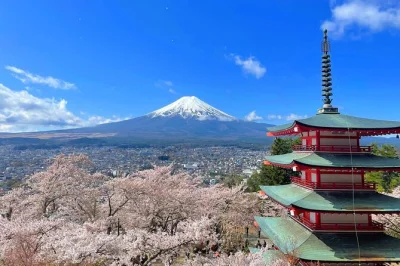
I’d always seen those photos of Mount Fuji — you know, the ones where it looks almost too perfect to be real? But standing at the base of Chureito Pagoda after climbing what felt like a million steps (it’s actually 398, but my legs would argue otherwise), I finally got it. The air was sharp and clean, and our guide, Yuki, pointed out how the clouds sometimes just hover around Fuji’s peak like it’s shy. I tried to catch my breath and take a photo at the same time — impossible. There were a few locals quietly praying at the shrine below; their calm felt contagious.
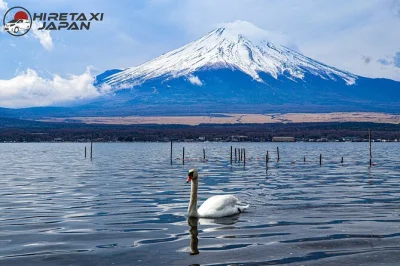
After that climb, we drove out past little towns until Lake Kawaguchi came into view. The water was so still that morning I could see Mount Fuji’s reflection almost perfectly — except for a duck paddling by and ruining the symmetry (which made me laugh). Oishi Park was full of colors I didn’t expect in late spring: purples and yellows everywhere along this path called Flowers Road. A couple of older women were tending to some plants near the edge; one handed me a sprig of lavender just because I looked curious. It smelled sweet but earthy, not like anything back home.
Oshino Hakkai was next — this village with eight ponds fed by snowmelt from Fuji itself. Our guide explained how it takes decades for water to trickle down through volcanic rock before it ends up in these pools. He handed us little cups to try it; honestly, I thought water was just water until that sip. It tasted ridiculously pure, almost cold even though it wasn’t straight from ice. There were school kids on a field trip giggling nearby and trying to feed koi with bits of bread.
The last stop was something I didn’t expect: a convenience store with this bright blue front right in front of Mount Fuji (Lawson Fujikawaguchiko Town Hall). Everyone lined up for photos — kind of silly but also fun. Inside I grabbed an onigiri for the ride back to Tokyo and watched as our group compared shots from the day. My legs were tired but my head felt clear somehow. Sometimes travel is just about seeing something you’ve seen in pictures your whole life and realizing it feels different when you’re actually there.
Similar tours
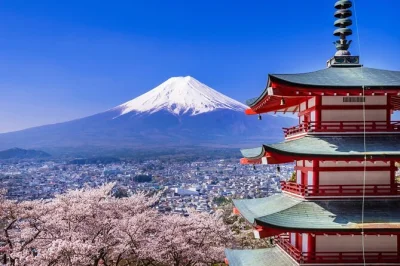 Mount Fuji & Lake Kawaguchi Day Tour from Tokyo with Scenic Stops
★★★★★★★★★★ 4.77 (1229) From US$ 57.60
Mount Fuji & Lake Kawaguchi Day Tour from Tokyo with Scenic Stops
★★★★★★★★★★ 4.77 (1229) From US$ 57.60
 Mt. Fuji & Kawaguchiko Private Day Trip from Tokyo with Guide
★★★★★★★★★★ 4.96 (402) From US$ 635.81
Mt. Fuji & Kawaguchiko Private Day Trip from Tokyo with Guide
★★★★★★★★★★ 4.96 (402) From US$ 635.81
 Mt. Fuji & Arakurayama Pagoda Day Trip with Lunch
★★★★★★★★★★ 4.85 (156) From US$ 97.82
Mt. Fuji & Arakurayama Pagoda Day Trip with Lunch
★★★★★★★★★★ 4.85 (156) From US$ 97.82
 Mount Fuji Day Trip from Tokyo: Private Tour & Pickup
★★★★★★★★★★ 4.69 (314) From US$ 466.26
Mount Fuji Day Trip from Tokyo: Private Tour & Pickup
★★★★★★★★★★ 4.69 (314) From US$ 466.26
 Mt Fuji Day Trip from Tokyo: Private Guide & Custom Stops
★★★★★★★★★★ 4.77 (491) From US$ 521.69
Mt Fuji Day Trip from Tokyo: Private Guide & Custom Stops
★★★★★★★★★★ 4.77 (491) From US$ 521.69
 Mt Fuji & Hakone Private Day Trip from Tokyo with Pickup
★★★★★★★★★★ 4.86 (170) From US$ 489.09
Mt Fuji & Hakone Private Day Trip from Tokyo with Pickup
★★★★★★★★★★ 4.86 (170) From US$ 489.09
 Mount Fuji Private Day Tour from Tokyo with Custom Stops
★★★★★★★★★★ 4.96 (167) From US$ 429.00
Mount Fuji Private Day Tour from Tokyo with Custom Stops
★★★★★★★★★★ 4.96 (167) From US$ 429.00
 Mt. Fuji & Kawaguchiko: 5th Station Day Trip with Cruise
★★★★★★★★★★ 4.73 (600) From US$ 78.25
Mt. Fuji & Kawaguchiko: 5th Station Day Trip with Cruise
★★★★★★★★★★ 4.73 (600) From US$ 78.25
 Tokyo to Mt. Fuji & Hakone: Private Day Trip with Custom Stops
★★★★★★★★★★ 4.83 (102) From US$ 408.22
Tokyo to Mt. Fuji & Hakone: Private Day Trip with Custom Stops
★★★★★★★★★★ 4.83 (102) From US$ 408.22
 Mt. Fuji & Lake Kawaguchi Day Trip with Cruise & Hōtō Cooking
★★★★★★★★★★ 4.78 (1687) From US$ 107.02
Mt. Fuji & Lake Kawaguchi Day Trip with Cruise & Hōtō Cooking
★★★★★★★★★★ 4.78 (1687) From US$ 107.02
 Private Mt. Fuji Tour: Lake Kawaguchi, Ropeway & Healing Village
★★★★★★★★★★ 4.89 (27) From US$ 782.54
Private Mt. Fuji Tour: Lake Kawaguchi, Ropeway & Healing Village
★★★★★★★★★★ 4.89 (27) From US$ 782.54
 Mt Fuji & Hakone: Private Day Trip with Hotel Pickup
★★★★★★★★★★ 4.86 (2518) From US$ 511.91
Mt Fuji & Hakone: Private Day Trip with Hotel Pickup
★★★★★★★★★★ 4.86 (2518) From US$ 511.91
 US$ 58.90


 Do you need help planning your next activity?


