

 +507 6792-0894


Sarnath Self-Guided Audio Tour: Buddha’s First Sermon Walk
 1h–1h 20m
 5.00
(1 reviews)
5.00
(1 reviews)








Summary
Explore Sarnath’s Buddhist Heritage with a Self-Guided Walking Tour
You’ll walk through Sarnath where Buddha gave his first sermon—exploring temples, ancient ruins, a peaceful deer park, and even seeing Ashoka’s pillar up close—all guided by your own audio tour so you can linger wherever you like.

Stepping out of the rickshaw, I could already hear distant temple bells and the low hum of morning prayers drifting through Sarnath. The air carried a mix of incense and fresh-cut grass from the nearby deer park. With my headphones on, I started the audio tour right at the gates—no guide waving a flag, just me and my phone, moving at my own pace.
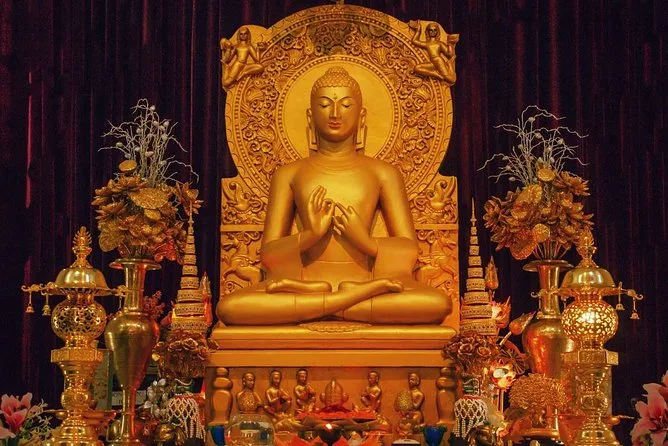
The first stop was the big Chinese Buddhist temple built in 1939. It’s hard to miss—the statues inside are carved from stone brought all the way from China and Myanmar, done in what our app called “brusni style.” I sat cross-legged for a moment in front of Buddha’s statue, surrounded by images of Chinese saints like Confucius and Mozi. There was this quiet hush inside, broken only by someone softly sweeping the floor.
Next up was Mulagandha Kuti Vihara. Turns out, it wasn’t here when Hiuen Tsang visited centuries ago; he described an older vihara that stood nearby during the Gupta period. The current building owes its existence to Angarika Dharmapala from Sri Lanka—he founded the Maha Bodhi Society and really shaped modern Sarnath. Our audio guide filled in these details as I wandered past brick ruins poking through patches of wildflowers.
The deer park (Mriga Vihara) is now more like a mini-zoo—kids were giggling at spotted deer while a peacock strutted along the fence. Even if you’re not traveling with children, it’s worth pausing here just to watch life go by under shady trees.
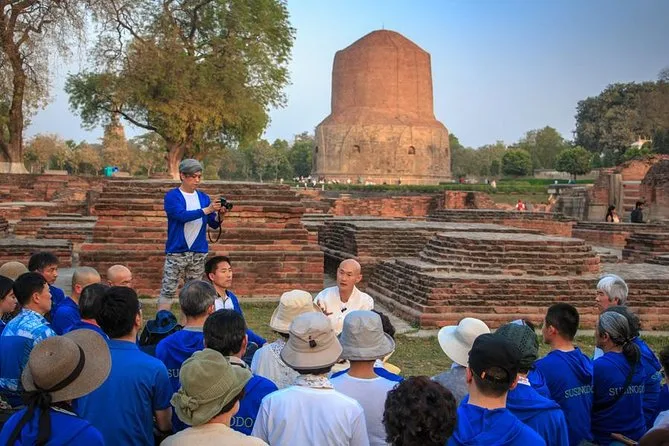
Ashoka’s stupa came into view next—a massive structure first built in 249 BC by Emperor Ashoka himself. The story goes that after witnessing so much bloodshed in battle, Ashoka turned to Buddhism right here in Sarnath. Standing beside those ancient stones, you can almost picture him making that choice.
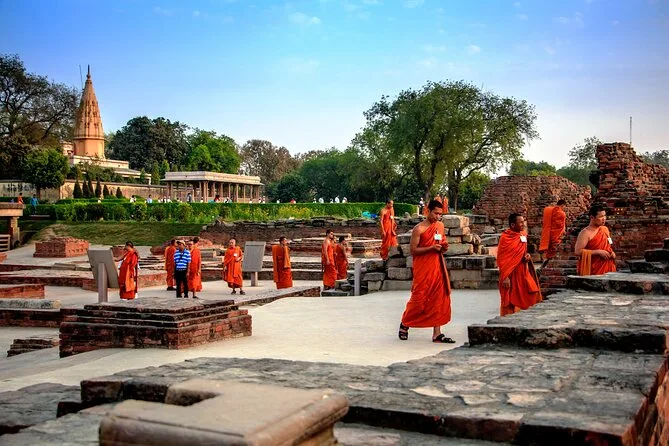
Scattered relics line the path—bits of old monasteries and weathered bricks telling stories of monks who once lived here. If you’re into archaeology or history, this spot is gold. I caught sight of some locals chatting near the ruins about recent excavations; apparently new finds still turn up every few years.
The broken pillar nearby is all that remains of Ashoka’s famous column. Its upper part sits safely inside Sarnath Museum now (which opens at 10 am—don’t come on Fridays though; it’s closed). You’ll have to leave your phone and camera outside before heading in, but it’s worth it just to see that sandstone lion capital up close. Each gallery has touchscreen displays explaining what you’re looking at—a small but fascinating place.
Later on, I wandered over to the Thai temple—built by Thailand’s government—with its giant standing Buddha statue rising above manicured lawns. At one point this was India’s tallest standing Buddha statue; kids were taking selfies while monks walked quietly around the base.
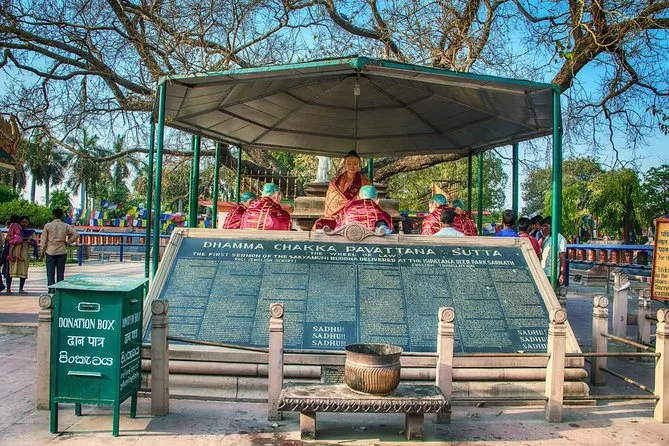
The final stretch led me down a familiar road—the same one we took coming from Varanasi—to where Buddha met his five disciples before giving his first sermon at Dhamekh Stupa on Vaishakh Purnima (which also happens to be both his birthday and death day). Excavations here uncovered statues showing Buddha turning the wheel of dharma—a powerful image if you pause long enough to take it in.
1h–1h 20m

Step-by-step itinerary
Day 1 — Explore Sarnath Buddhist Sites
- Visit temple with Chinese-style Buddha statues
- See MulagandhaKutiVihara temple history
- Walk through MrigaVihara deer park
- View Ashoka's original stupa site
- Explore ancient Buddha Vihara ruins
- See remains of Ashoka's broken pillar
- Tour Archaeological Museum
- Visit Thai temple with large Buddha statue
- View Dhamekh Stupa, site of Buddha's first sermon

Top questions

Can I do this audio tour any time of day?
Yes! You can start whenever suits you best since it’s self-guided—just check museum hours if you want to go inside (10 am–5 pm; closed Fridays).
Is this tour suitable for families with young kids?
Absolutely—the deer park is popular with children and most paths are easy to walk with strollers or little ones in tow.
Do I need internet access during the walk?
Nope! Once you’ve downloaded everything onto your phone via Wi-Fi or data beforehand, you’re good to go offline during your visit.
How long does it usually take?
If you listen straight through without lingering too long at each stop, about 2–3 hours covers most highlights—but there’s no rush!

What’s included
Your ticket gives you unlimited access to the audio-guided walking tour for three months using your own device. You can explore at any time and revisit spots as often as you like within that period.
 Super deal
  Free booking, free cancellation.
  Don't lose your place.


 Do you need help planning your next activity?
  +507 6792-0894


